
Histotripsy
Treat liver tumors with sound, without needles.
Histotripsy uses focused pulses of ultrasound, aimed from outside the body, to break a liver tumor apart. There is no needle and no cut. It was cleared by the FDA for liver tumors in 2023, so it is still new.
- No needles or cuts
- 1–3 hours
- General anesthesia
- Often home next day
 Fabio Komlos, MDInterventional radiologist
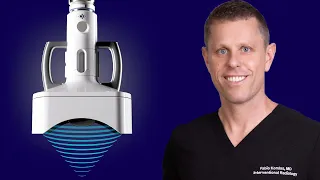 Watch the video explanation14:23 video · Cancer Treatment Breakthrough: How Histotripsy Transforms Tumor Removal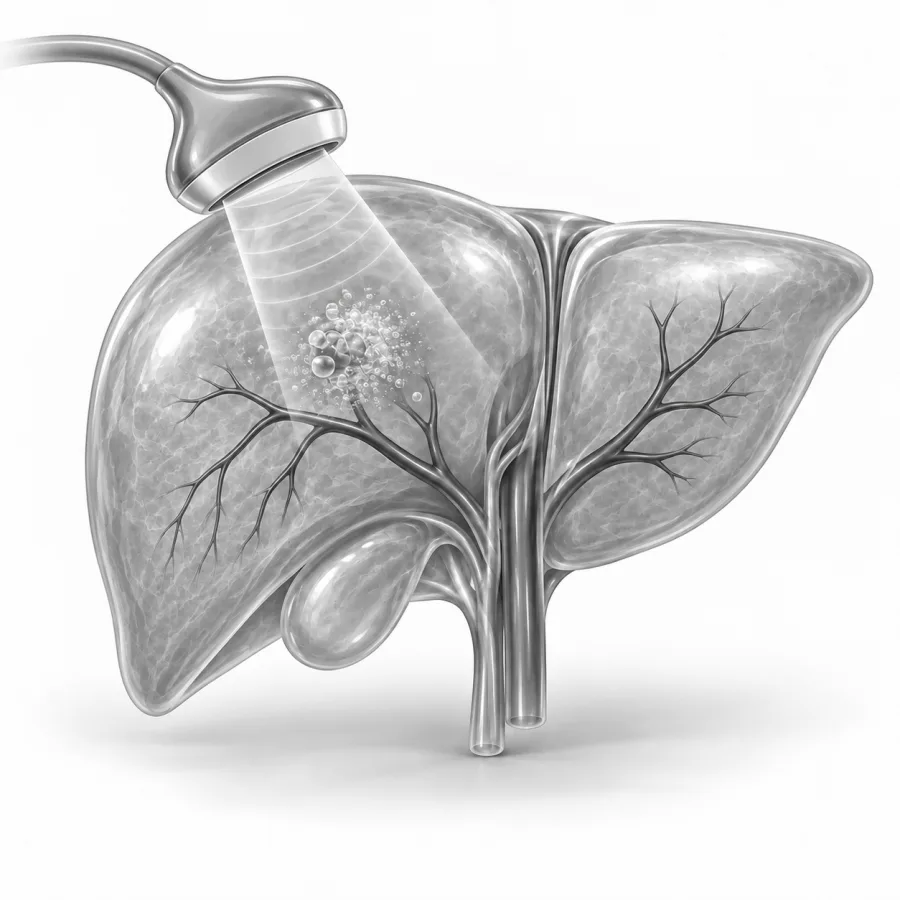
Sound waves pass through the skin to reach the tumor.
Cancer Treatment Breakthrough: How Histotripsy Transforms Tumor Removal
Dr. Fabio Komlos walks through histotripsy the way he explains it in clinic, using the same images he uses to plan treatment.
Fabio Komlos, MDInterventional radiologist · 14:23Revolutionary Non-Invasive Cancer Treatment: No Incisions, No Needles!
0:52
How Interventional Radiologists Treat Liver Tumors Without Surgery — at is liver-directed therapy?
5:43
Quick answers
Under a minute eachWhat is histotripsy?
Histotripsy is a way to destroy a tumor using sound. A treatment head filled with water rests on your skin, over the liver. It sends very short, very powerful pulses of ultrasound that all meet at one small point inside the tumor. At that point, the pulses create clouds of tiny bubbles that form and collapse in millionths of a second. That rapid motion breaks the tumor cells apart, turning the tumor into a liquid that the body clears away over the following weeks to months.
Unlike microwave ablation or cryoablation, histotripsy does not use heat or cold, and nothing goes through the skin. The machine moves the focal point in a pattern until the whole tumor, plus a thin safety margin, has been treated.
The FDA cleared the first histotripsy system for treating liver tumors in October 2023. That makes it one of the newest treatments in cancer care. Early results are encouraging, but long-term results, such as how often tumors come back after several years, are still being studied.
During treatment, the tumor is watched on live ultrasound. The treated area appears as a bright, shimmering cloud of bubbles, and afterward it shows up on MRI or CT as a darker, rounded zone where the tumor used to be.
Who it may help
Histotripsy is cleared for tumors in the liver, both cancers that start in the liver, called hepatocellular carcinoma (HCC), and cancers that have spread to the liver from elsewhere, such as the colon. It may be an option when surgery is not a good choice or when you would prefer to avoid needles, and sometimes it is used alongside other treatments. It is being studied for the kidney, pancreas and other organs, but those uses are still in clinical trials.
The biggest limit is access. Ultrasound has to reach the tumor through a clear window. Ribs, lung and gas in the bowel block sound, so some tumors cannot be reached even if they are small.
May be a good fit
- One or a few liver tumors, usually a few centimeters or smaller
- Tumor clearly seen on ultrasound
- Tumors near large blood vessels or bile ducts, which can be hard to treat with heat
- Not a good candidate for surgery, or prefers a non-invasive option
- Healthy enough for general anesthesia
May not be right if
- The tumor is hidden behind ribs, lung or bowel
- Many tumors or cancer widespread in the body
- The tumor cannot be seen well on ultrasound
- You cannot have general anesthesia
- A proven treatment would clearly suit you better
How it compares with other liver treatments
| Histotripsy | Microwave ablation | Surgery | |
|---|---|---|---|
| How it reaches the tumor | Ultrasound from outside the body | Needle through the skin | Incision or keyhole surgery |
| How it destroys the tumor | Bubbles break up cells mechanically | Heat | The tumor is removed |
| Anesthesia | General | Sedation or general | General |
| Typical stay | Same day or one night | Same day or one night | Several days |
| Long-term evidence | Limited, still growing | Many years of data | Many years of data |
Other options include Y-90 radioembolization, chemoembolization, focused radiation (SBRT) and medicines. Because histotripsy is new, we compare it honestly with treatments that have longer track records before recommending it.
How to prepare
- You will have recent blood tests and a CT or MRI, and an ultrasound to check that the tumor can be seen and reached.
- You will meet with anesthesia, since the treatment is done under general anesthesia.
- Do not eat or drink after midnight. Take morning medicines with a small sip of water if we tell you to.
- Ask us about blood thinners. They may need to be paused. See blood thinners.
- Plan for an adult to drive you home and stay with you the first night.
What happens during treatment
- 1Anesthesia
You are put fully to sleep so you stay still. The anesthesia team can also control your breathing, which keeps the liver steady.
- 2Setting up
The treatment head, with a water bath or bag on its face, is placed on your skin over the liver. We use its built-in ultrasound to find the tumor and plan the treatment zone.
- 3Treatment
The machine sends rapid pulses of focused ultrasound and moves the focal point through the whole tumor. We watch the treated area on live ultrasound the entire time.
- 4Waking up
You wake in recovery with no incision and no stitches. Many people go home the same day or the next morning.
Recovery and results
Most people have mild soreness over the treated area and feel tired for a few days. Some have a low fever or nausea. Many return to light activity within a few days.
- First 24 hoursRest. No driving for 24 hours after anesthesia. Mild soreness is common.
- Days 2–7Most people resume light daily activities. Tiredness is the most common complaint.
- About 1–2 monthsAn MRI or CT checks that the whole tumor was treated. The treated area slowly shrinks as the body absorbs it.
- Every few monthsRegular scans watch for any tumor that comes back, as after any liver tumor treatment.
In the main study that led to FDA clearance, the planned treatment zone was fully treated in about 95 in 100 tumors, and serious complications were uncommon. These were short-term results in a limited number of patients. How well histotripsy controls tumors over years, and how it compares head to head with other treatments, is still being measured.
I am excited about histotripsy, and I am also careful with it. The first thing I do is look at the tumor on ultrasound myself, because if sound cannot get a clear path, the machine cannot treat it. Then I lay out, side by side, what we know about histotripsy and what we know about options with longer track records, so you can choose with clear eyes.Fabio Komlos, MD, interventional radiologist · About Dr. Fabio Komlos
Risks and what is still unknown
- Soreness, tiredness and mild fever for a few days.
- Risks of general anesthesia, which your anesthesia team will review with you.
- Bleeding or injury to nearby organs, uncommon.
- Skin irritation where the treatment head sat, uncommon.
- Tumor coming back in or near the treated area. Long-term rates are not yet well known.
- Insurance and access: because it is new, coverage varies and not every center offers it.
Common questions
Is histotripsy really needle-free?
Is it the same as HIFU?
Is it proven?
Does it hurt?
Can it treat tumors outside the liver?
Can I still have chemotherapy, surgery or other treatments?
Will insurance cover it?
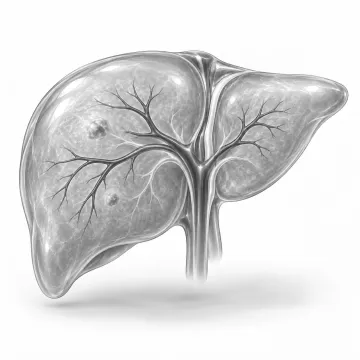
Liver tumors
Primary liver cancer and liver metastases: what they are and every way to treat them.
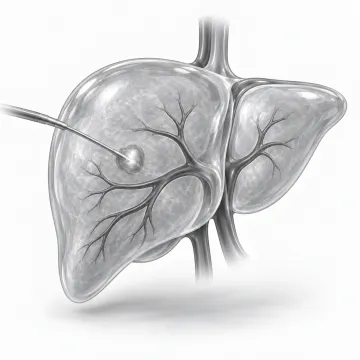
Microwave ablation
Heat small liver, lung or kidney tumors through a needle, often with a same-day or overnight stay.
Tumor ablation
Heat or freeze a tumor through a needle, with no incision and a short recovery.
Y-90 radioembolization
Tiny radioactive beads treat liver tumors from inside, with two short outpatient visits.
Written for patients by the Palo Alto Interventional team. General information only; your own plan depends on your health and imaging.
Talk to us about your options
Request a consultation online, or call 650-404-8445, Monday to Friday, 8 am to 5 pm. You can also ask your doctor to send a referral. We will review your imaging and help you decide whether a procedure makes sense.