
Cryoablation
Freeze a tumor through a needle, without surgery.
Cryoablation destroys tumors by freezing them with thin needles placed through the skin under CT guidance. It is used for small tumors in the kidney, lung and bone, and some breast tumors. Most people go home the same day or next morning.
- Hospital procedure
- 1–3 hours
- Sedation or anesthesia
- Home same day or next
 Fabio Komlos, MDInterventional radiologist
 Watch the video explanation14:09 video · Renal Cryoablation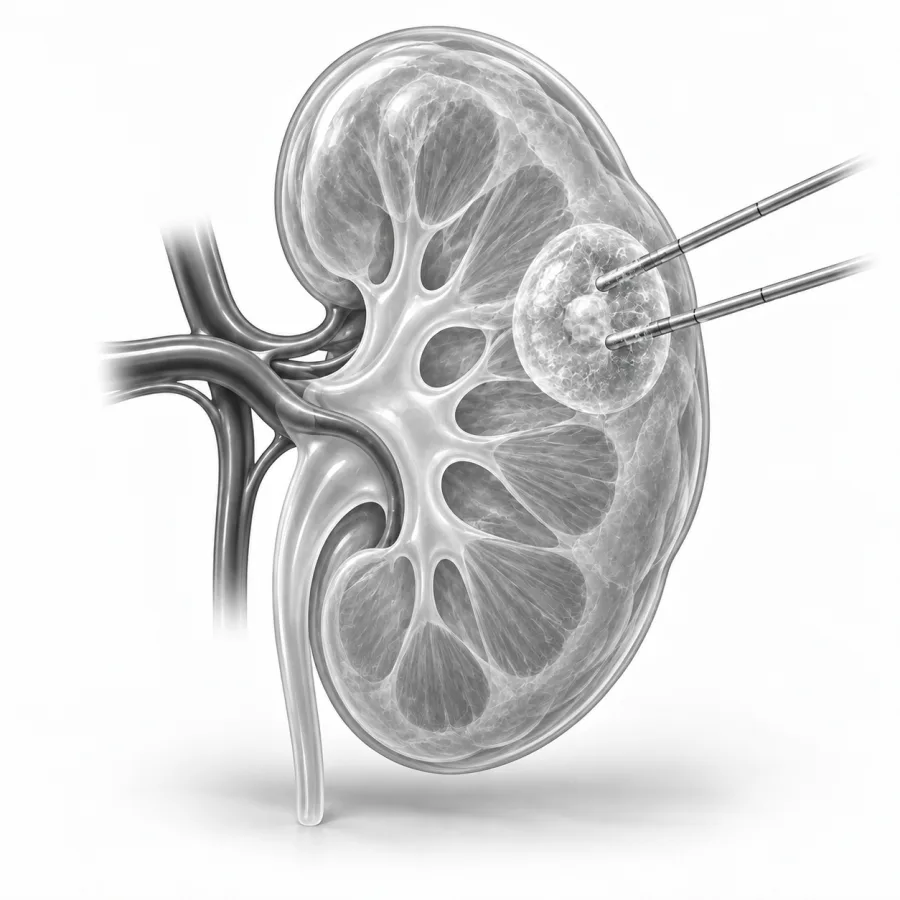
We watch the freeze cover the tumor on CT.
Renal Cryoablation
Dr. Fabio Komlos walks through cryoablation the way he explains it in clinic, using the same images he uses to plan treatment.
Fabio Komlos, MDInterventional radiologist · 14:09Lung Cryoablation
11:06
Minimally Invasive Cancer Treatment Explained Tumor Ablation Options
3:49
Does Tumor Ablation Really Work? Clearing Up the Biggest Misconceptions
4:05
Quick answers
Under a minute eachWhat is cryoablation?
Cryoablation is a type of tumor ablation that uses extreme cold. We place one or more thin needles, called cryoprobes, through the skin and into the tumor. Gas flowing inside the tips makes them very cold, and an ice ball grows around them. Freezing, thawing, and freezing again tears the tumor cells apart and shuts down their tiny blood vessels.
Its main advantage is that ice shows up clearly on CT. We can watch the ice ball grow and make sure it covers the whole tumor plus a safety margin, while keeping it away from nearby structures. Freezing also numbs tissue, so it tends to be less painful afterward than heat-based ablation, which is helpful for tumors near the chest wall, nerves or bone.
On CT, the ice ball appears as a dark, sharply outlined oval around the probe tips. We check that it reaches past every edge of the tumor before we stop.
What it treats, and who it helps
- Kidney: small kidney tumors, usually 4 cm or less, especially in people who are older, have other health problems, or need to protect kidney function. It is a guideline-supported alternative to partial kidney removal for many small tumors.
- Lung: small lung cancers in people who are not good surgical candidates, and a limited number of tumors that spread to the lung.
- Bone and soft tissue: painful bone metastases, and some benign tumors such as desmoid tumors. See cancer pain treatment.
- Breast: benign fibroadenomas, and in selected women, small low-risk breast cancers, usually as part of specialized programs or studies.
Often a good fit
- A small tumor, usually under 3–4 cm
- Surgery would be risky or would remove too much healthy organ
- One kidney, or kidney function you need to protect
- Tumor next to nerves, chest wall or bone
May not be right if
- The tumor is large or there are many
- A bleeding problem cannot be corrected
- The tumor touches bowel or other structures that cannot be moved away
- Surgery offers you a clearly better chance of cure
How it compares with the alternatives
| Cryoablation | Microwave ablation | Surgery | |
|---|---|---|---|
| How | Freezing through needles | Heat through a needle | Tumor removed through incisions |
| Seeing the treatment zone | Ice ball clearly visible on CT | Harder to see | Direct view |
| Pain afterward | Usually mild | Mild to moderate | More, from incisions |
| Typical stay | Same day or one night | Same day or one night | Several days |
| Return to normal activities | Few days to a week | Few days to a week | Several weeks |
Other options include microwave ablation, focused radiation (SBRT), and for some small kidney tumors, careful watching with regular scans, called active surveillance. We will talk through each one with you.
How to prepare
- You will have blood tests and a recent CT or MRI. Many tumors are biopsied first, sometimes at the start of the same procedure.
- Do not eat or drink after midnight. Take morning medicines with a small sip of water unless told otherwise.
- Blood thinners usually need to be paused. We will give you exact instructions. See blood thinners.
- Pack a small overnight bag in case you stay one night.
- Arrange for an adult to drive you home.
What happens during the procedure
- 1Getting ready
You receive moderate sedation or general anesthesia, depending on the tumor. You lie on the CT table in the position that gives the safest path to the tumor, often on your stomach or side.
- 2Placing the probes
We numb the skin and use CT images to guide one or more thin cryoprobes into the tumor. If bowel or another organ is close, we may inject fluid or gas to gently push it away.
- 3Freezing
We run two freeze cycles, usually about 10 minutes each, with a thaw in between. CT scans during the freeze confirm that the ice ball covers the whole tumor.
- 4Finishing
The probes are warmed and removed. A small bandage covers each tiny skin puncture. A final scan checks for bleeding or, in the lung, a collapsed lung.
Recovery
- First few hoursYou rest in recovery while nurses check your vital signs. After a lung treatment, a chest X-ray checks the lung. You can eat and drink once awake.
- Day 1Many people go home the same day or the next morning. No driving for 24 hours after sedation.
- Days 2–7Soreness at the needle site is common and should get better each day. After kidney treatment, pink urine for a day or two can be normal. Some people have flu-like aches for several days.
- About 1 weekMost people are back to normal activities. We see you for a check-up.
- About 1–3 monthsA CT or MRI checks that the tumor was fully treated, followed by regular scans.
Results and risks
For small kidney tumors, published studies show cryoablation controls the tumor in roughly 9 out of 10 cases, and many tumors that come back can be treated again. For painful bone tumors, most people notice less pain within days to a couple of weeks. Results in the lung depend on tumor size and type.
- Bleeding, slightly more likely than with heat because freezing does not seal vessels. Blood in the urine after kidney treatment usually clears on its own.
- Collapsed lung (pneumothorax) after lung treatment, sometimes needing a small chest tube for a day or two. See pneumothorax.
- Nerve irritation, causing numbness or tingling in the skin nearby, usually temporary.
- Skin injury from cold near a shallow tumor, rare because we protect the skin.
- Infection, rare.
- Tumor coming back, which is why regular follow-up scans matter.
What I love about cryoablation is that I can see what I am doing. I watch the ice ball grow on every scan and stop only when it has swallowed the tumor with room to spare. When a tumor sits near a nerve, the bowel or the skin, I plan the probe angles to protect those structures before I ever start freezing.Fabio Komlos, MD, interventional radiologist · About Dr. Fabio Komlos
Common questions
Does freezing hurt?
Will the tumor disappear?
Do I need a biopsy first?
When can I drive and go back to work?
Can it be repeated?
Is it better than surgery?
Will insurance cover it?
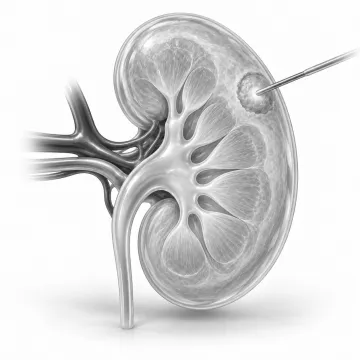
Tumor ablation
Heat or freeze a tumor through a needle, with no incision and a short recovery.
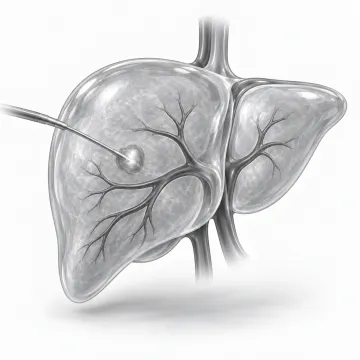
Microwave ablation
Heat small liver, lung or kidney tumors through a needle, often with a same-day or overnight stay.
Cancer pain treatment
Nerve blocks, spine and bone procedures, and pain pumps for cancer pain medicines cannot control.
Lung biopsy
Find out what a lung nodule is with a CT-guided needle biopsy, usually home the same day.
Kidney biopsy
Diagnose kidney disease or check a transplant with an ultrasound-guided needle sample.
Written for patients by the Palo Alto Interventional team. General information only; your own plan depends on your health and imaging.
Talk to us about your options
Request a consultation online, or call 650-404-8445, Monday to Friday, 8 am to 5 pm. You can also ask your doctor to send a referral. We will review your imaging and help you decide whether a procedure makes sense.