
Kidney biopsy
Find the cause of kidney disease and treat it.
A medical kidney biopsy takes 2 or 3 thin samples of kidney tissue through a needle in the back, guided by ultrasound or CT. The needle part takes 10 to 30 minutes, followed by an overnight hospital stay.
- Overnight stay
- 10–30 minutes
- Moderate sedation
- Back to normal in 1 wk
 Fabio Komlos, MDInterventional radiologist
 Watch the video explanation5:24 video · Medical Renal Biopsy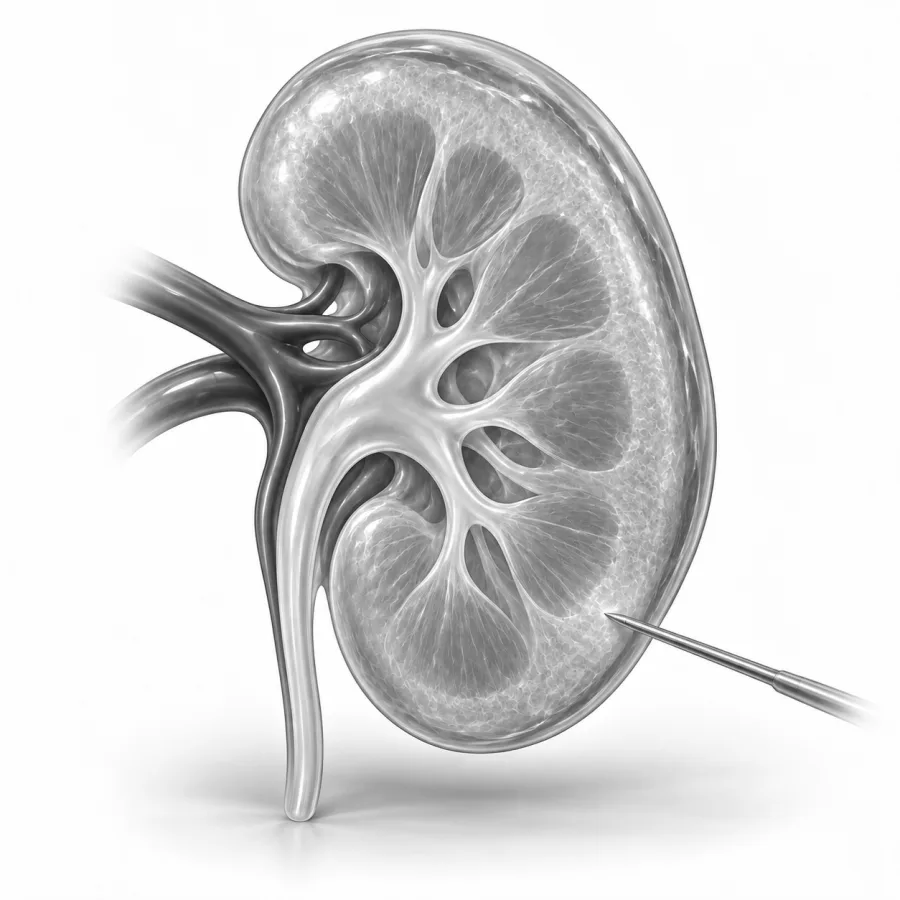
 On imaging
Renal angiogram: the artery to the kidney and its branches.
Medical Renal Biopsy
Dr. Fabio Komlos walks through kidney biopsy the way he explains it in clinic, using the same images he uses to plan treatment.
Fabio Komlos, MDInterventional radiologist · 5:24Renal Failure Treatment Options Dialysis — Kidney Transplant Explained
3:32
If you are having a procedure and you are on blood thinners you need to watch this
10:17
Quick answers
Under a minute eachWhat is a medical kidney biopsy?
A medical kidney biopsy, also called a renal biopsy, takes a few thin strips of kidney tissue so a kidney pathologist can study them. It is used when the kidney itself is not working properly, not to sample a lump.
Each kidney has about a million tiny filters called glomeruli. Blood and urine tests can show that these filters are leaking protein or blood, or that kidney function is dropping. Only a biopsy can show why. The pathologist looks at the tissue with a regular microscope, with special stains for immune proteins and with a very powerful electron microscope.
What we seeWhy your kidney doctor may recommend it
- Protein in the urine, especially a large amount (nephrotic syndrome)
- Blood in the urine seen under the microscope, with protein or falling kidney function
- Kidney function that drops quickly without a clear cause
- Suspected kidney involvement from lupus, vasculitis or other immune diseases
- A transplanted kidney that is not working as well, to check for rejection or infection
The result often changes treatment. It can show whether steroids or other immune medicines will help, how much permanent scarring there is and what to expect over time. For a transplant, it can separate rejection, which needs stronger anti-rejection medicine, from drug side effects or infection.
Good candidates
- Two working kidneys of normal size, or a transplant kidney
- Blood pressure that is controlled
- Able to stop blood thinners for a few days
- Able to lie still on the stomach for about 30 minutes
May need to wait or choose another option if
- Blood pressure is very high on the day
- You have a bleeding disorder that cannot be corrected
- Both kidneys are small and scarred, so a biopsy would not change care
- You have an active kidney or skin infection
How to prepare
- 1Stop blood thinners and anti-inflammatory medicines as instructed. These include aspirin, ibuprofen (Advil, Motrin), naproxen, warfarin (Coumadin), clopidogrel (Plavix), apixaban (Eliquis), rivaroxaban (Xarelto), fish oil and ginkgo. Your kidney doctor and our team will agree on the timing. See blood thinners.
- 2Keep taking your blood pressure medicines, including the morning of the biopsy, with a small sip of water.
- 3Do not eat or drink after midnight, or for at least 8 hours before.
- 4Pack for an overnight stay and leave jewelry and valuables at home.
- 5Arrange for an adult to drive you home the next day.
When you arrive, a nurse starts an IV and draws blood to check your blood count, clotting and kidney function. See before your procedure for more.
What happens during the biopsy
- 1Getting ready
In the interventional suite at El Camino Hospital, you lie on your stomach, often with a pillow under your belly. For a transplant kidney, which sits in the lower belly, you lie on your back. You receive moderate (twilight) sedation.
- 2Finding the kidney
We find the kidney with ultrasound or CT, clean the skin and numb it and the path down to the kidney.
- 3Taking the samples
We ask you to hold your breath for a few seconds while a spring-loaded needle takes each sample. You hear a click and feel a push. A pathology technologist checks under a microscope that the samples contain enough filters.
- 4Finishing up
We remove the needle, press on the site, check the kidney for bleeding on ultrasound and apply a small bandage.
For a kidney biopsy, I aim for the outer rim at the lower tip of the kidney and stay away from the center, where the larger vessels run. I work closely with the pathology technologist so we stop as soon as we have enough filters, not one pass more. I also check your blood pressure myself before we start, because good control is one of the best ways to prevent bleeding.Fabio Komlos, MD, interventional radiologist · About Dr. Fabio Komlos
The overnight stay and recovery
- First 4–6 hoursStrict bed rest, lying flat. Nurses check your blood pressure, the site and your urine often. You can eat and drink, and family can visit.
- OvernightYou stay in a hospital room for observation. Pink urine for a day or two is common.
- Next morningA blood test compares your blood count with the day before. If it is stable and you feel well, you usually go home before noon.
- First weekNo heavy lifting, hard exercise, contact sports, baths or swimming. Light activity and desk work are fine.
Mild soreness in the back is normal for 2 to 3 days. An ice pack and acetaminophen (Tylenol) usually help. Avoid ibuprofen and naproxen. Ask your kidney doctor when to restart blood thinners.
Results
Kidney biopsies need several kinds of testing, including electron microscopy, so the full report usually takes 1 to 2 weeks. A preliminary result may come sooner if treatment is urgent. Your kidney doctor will go over the results and the treatment plan with you.
Risks
The kidney has a rich blood supply, so bleeding is the main risk. A small bruise around the kidney is common and usually causes no problems. Visible blood in the urine happens in about 1 in 20 to 1 in 30 people and usually clears within a day or two. About 1 in 100 people need a blood transfusion, and fewer than 1 in 100 need a procedure to seal the bleeding artery (embolization). Losing the kidney is extremely rare.
Other risks, such as infection or a small abnormal connection between an artery and a vein, are rare. Most such connections close on their own.
Common questions
Why do I have to stay overnight?
Is it normal to see blood in my urine?
Does it hurt?
Will a biopsy damage my kidney?
Is a transplant kidney biopsy different?
When can I go back to work?
Image-guided biopsies
Get a tissue diagnosis through a needle, guided by ultrasound or CT, usually without an incision.
Understanding your dialysis access
Fistula, graft, catheter or PD: how each works, daily checks and warning signs.
Interventional urology
Drains and stents that relieve a blocked kidney, placed with X-ray guidance through the skin.
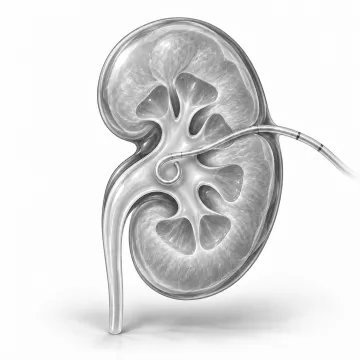
Nephrostomy tube
A thin drain from the kidney through the back that relieves a blockage or infection.
Written for patients by the Palo Alto Interventional team. General information only; your own plan depends on your health and imaging.
Talk to us about your options
Request a consultation online, or call 650-404-8445, Monday to Friday, 8 am to 5 pm. You can also ask your doctor to send a referral. We will review your imaging and help you decide whether a procedure makes sense.