
Central lines
Get your treatment without a new needle every time.
A central line is a thin tube that ends in a large vein near your heart, so you can receive chemotherapy, antibiotics or nutrition without repeated needle sticks. The three main types are PICC lines, tunneled lines and ports.
- Weeks to years
- Placed in 15–45 min
- Local or sedation
- Most go home same day
 Fabio Komlos, MDInterventional radiologist
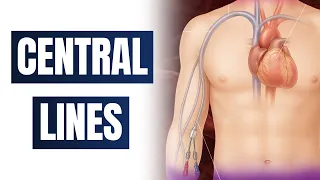 Watch the video explanation23:01 video · What You Need to Know About Central Lines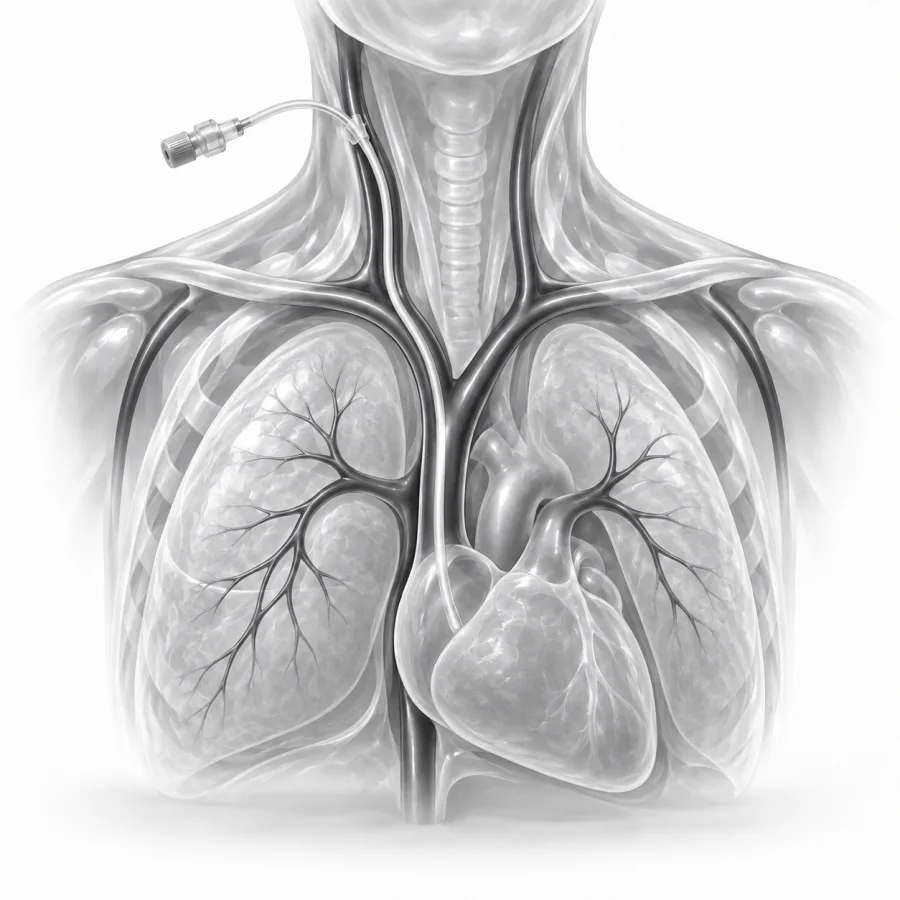
What You Need to Know About Central Lines
Dr. Fabio Komlos walks through central lines the way he explains it in clinic, using the same images he uses to plan treatment.
Fabio Komlos, MDInterventional radiologist · 23:01Central Lines 101 PICC, Tunneled Lines — Ports Explained
3:57
How to Flush a Catheter Correctly?
5:54
Risks of Central Lines You Should Know
2:08
Quick answers
Under a minute eachWhat is a central line?
A regular IV sits in a small vein in your hand or arm and lasts a few days. A central line, also called a central venous catheter, is a longer, soft tube whose tip rests in the large vein that enters the heart. Blood flow there is fast, so strong medicines are diluted right away and do not irritate the vein.
Central lines are used for chemotherapy, long courses of IV antibiotics, IV nutrition, frequent blood draws and transfusions. Interventional radiologists place them with ultrasound and X-ray guidance, so the tip lands exactly where it should.
The three main types
- PICC line (peripherally inserted central catheter): placed in a vein in the upper arm, with the tip near the heart. Best for weeks to a few months. It stays outside the skin and needs weekly care. See PICC lines.
- Tunneled central line: placed in a neck vein and run under the chest skin, with one or more ends coming out on the chest. A fabric cuff under the skin holds it in place. Used for months, for frequent daily treatments or when a line is needed for large flows. Dialysis catheters are a special kind. See dialysis catheters.
- Port (implanted port): a small disc placed completely under the skin of the upper chest, connected to a thin tube in the vein. It is reached with a special needle when needed. Best for months to years of on-and-off treatment, such as chemotherapy. See ports.
| PICC line | Tunneled line | Port | |
|---|---|---|---|
| Where | Upper arm | Chest, entering the neck vein | Under the chest skin |
| Usual length of use | Weeks to about 3 months | Weeks to months | Months to years |
| Visible outside the body | Yes | Yes | No, only a small bump |
| Care at home | Weekly dressing and flushes | Weekly dressing and flushes | Flush about every 4–12 weeks when not in use |
| Showering and swimming | Cover to shower; no swimming | Cover to shower; no swimming | Normal once healed |
| Placement | Local numbing, about 15 minutes | Sedation, about 20–30 minutes | Sedation, about 30–45 minutes |
How to choose
The choice is made together with your oncologist, infectious disease doctor or other treating doctor. We think about how long you need the line, how often it will be used, what will run through it, and how it fits your daily life.
- A few weeks of antibiotics: a PICC is usually simplest.
- Chemotherapy every few weeks for months: a port is often best, because nothing sticks out between treatments and infection risk is low.
- Daily or continuous infusions for months, or large-volume needs: a tunneled line may work better.
- Chronic kidney disease: tell us. PICC lines can damage the arm veins that a future dialysis fistula will need, so a tunneled line or port is usually preferred.
When I help choose a line, my first question is how long and how often it will be used, and my second is what the patient wants their daily life to look like. A swimmer starting a year of chemotherapy and a retiree needing six weeks of antibiotics need very different lines. For anyone with kidney disease, I try hard to keep a PICC out of their arms, because those veins may be their future dialysis access.Fabio Komlos, MD, interventional radiologist · About Dr. Fabio Komlos
What are the risks?
Central lines are placed safely every day, but they are still a foreign tube inside a vein. The main risks are infection and clots, and both grow the longer a line stays in. That is why a line should be removed as soon as it is no longer needed.
- Infection at the skin or in the bloodstream. Fever or chills are often the only sign.
- Blood clot in the vein around the line, which can cause arm, neck or face swelling and is usually treated with blood thinners. See DVT and blood clots.
- Blockage of the line, often cleared with a clot-dissolving medicine.
- Bleeding or bruising where the line was placed, usually minor.
- Collapsed lung (pneumothorax) or a line that moves out of position, both uncommon with ultrasound and X-ray guidance.
Caring for your line and flushing
Most line problems, infections and clots, are preventable with good daily habits. Your home infusion or oncology nurse will teach you, and our video on flushing shows the steps. If you flush your own line, follow the exact instructions from your nurse.
Good habits
- 1Wash your hands well, or use hand sanitizer, before touching the line.
- 2Scrub the connector (the cap on the end) with an alcohol or chlorhexidine pad for about 15 seconds and let it dry before connecting anything.
- 3Use only prefilled 10 mL (or larger) syringes. Smaller syringes push with too much pressure and can damage the line.
- 4Flush with a push-pause rhythm, short bursts rather than one long push, which helps clear the tube.
- 5Never force a flush. If it will not go in, stop and call your nurse or us.
- 6Keep the dressing clean, dry and sealed. Have it changed on schedule, usually weekly, or sooner if it is wet, loose or dirty.
Explore in detail
Common questions
Which line is least likely to get infected?
Can I have scans with a central line?
Does placement hurt?
What happens when I no longer need it?
Will insurance cover a central line?
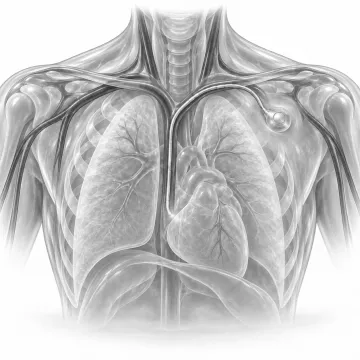
Ports
A small device under the chest skin for chemo, infusions and blood draws.
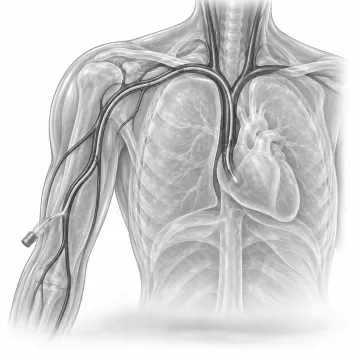
PICC lines
A thin arm line for weeks of IV antibiotics, nutrition or chemotherapy.
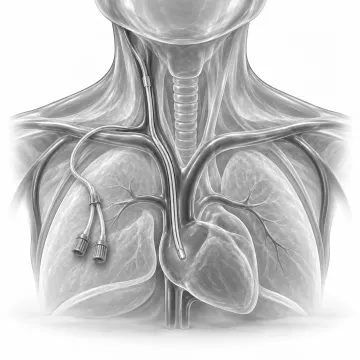
Tunneled dialysis catheters
A soft tube in the chest that allows hemodialysis the same day it is placed.
Palliative cancer care
Small procedures that ease fluid build-up, pain, blockages and eating problems caused by cancer.
DVT (deep vein blood clots)
Blood clots in the leg or arm: signs, blood thinners, clot removal and long-term care.
Written for patients by the Palo Alto Interventional team. General information only; your own plan depends on your health and imaging.
Talk to us about your options
Request a consultation online, or call 650-404-8445, Monday to Friday, 8 am to 5 pm. You can also ask your doctor to send a referral. We will review your imaging and help you decide whether a procedure makes sense.