
Ports
Fewer needle sticks through months of treatment.
A port is a small disc placed under the skin of your upper chest, connected to a thin tube in a large vein. Placement takes about 30–45 minutes under sedation, and the port can be used the same day.
- Outpatient
- 30–45 minutes
- Moderate sedation
- Usable the same day
 Fabio Komlos, MDInterventional radiologist
 Watch the video explanation4:28 video · Mediport Placement Video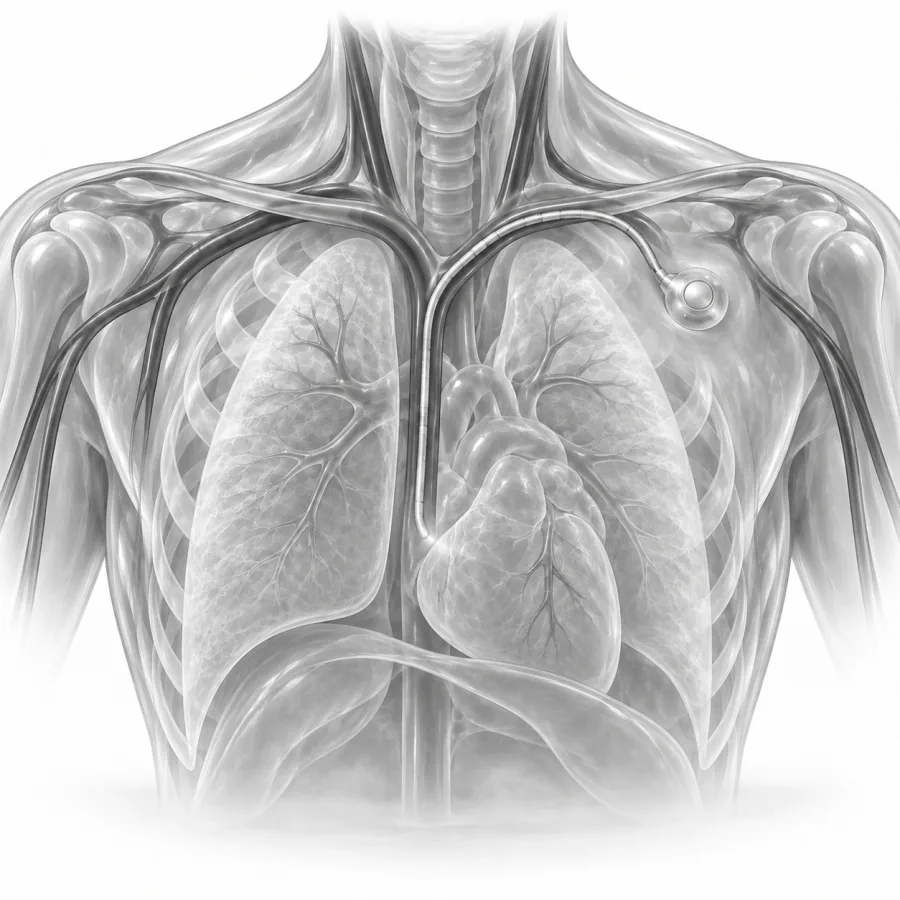
Shower, swim and exercise normally once it heals.
Mediport Placement Video
Dr. Fabio Komlos walks through ports the way he explains it in clinic, using the same images he uses to plan treatment.
Fabio Komlos, MDInterventional radiologist · 4:285 Common Mediport Misconceptions That Patients Get Wrong
6:18
Mediport Removal
4:43
What You Need to Know About Central Lines
23:01
Quick answers
Under a minute eachWhat is a port?
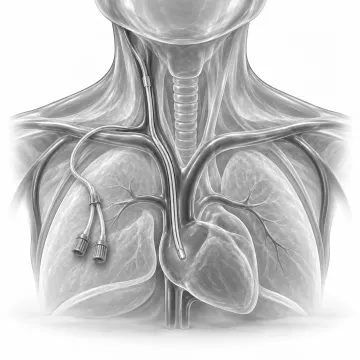
A port, also called a mediport, implanted port or port-a-cath, is a small medical device that sits completely under your skin, usually a couple of inches below your collarbone. It has a round chamber about the size of a large coin, with a thick self-sealing silicone top. A thin, soft tube, the catheter, runs from the chamber into a large vein, with its tip resting where that vein meets the heart.
To use the port, a nurse presses a special bent needle, called a Huber needle, through your skin into the silicone top. Medicine then flows straight into the large vein, and blood can be drawn out. When treatment is done for the day, the needle is removed and nothing is left outside your body except a small bump.
On a chest X-ray, the port shows up as a bright round disc under the collarbone, with a thin line curving up into the neck and then down to the heart.
Who benefits from a port
A port is a good choice if you need IV treatment on and off for months, especially chemotherapy. It is also used for frequent blood draws, blood transfusions, iron infusions, immune treatments, and long-term IV medicines. It helps when your arm veins are small or hard to find, and it protects arm veins from medicines that irritate them.
A port is often best when
- Treatment will last several months or more
- Treatments happen every few days or weeks, not continuously
- You want to shower, swim and exercise normally between treatments
- Your arm veins are hard to access
Another line may be better if
- You need IV treatment for only a few weeks (a PICC may be simpler)
- You need continuous daily infusions (a tunneled line may work better)
- You have an active bloodstream infection
- You need a line today and cannot wait for the procedure
For a side-by-side look at all the options, see central lines.
Common misconceptions
- "A port is a big surgery." It is a short outpatient procedure through a small incision, done under moderate sedation. Most people go home within an hour.
- "I will not be able to shower or swim." Once the incision heals, usually in about a week, you can shower, swim and bathe normally when the port is not accessed.
- "Everyone will see it." It shows as a small bump under the skin that most clothing covers.
- "It will set off airport security or rule out MRI." Ports rarely set off metal detectors, and the ports we use are safe for MRI under standard conditions. Carry your device card.
- "The port needs care every day." When it is not being used, it only needs a flush, usually every 4–12 weeks depending on your treatment center.
- "It should stay in forever, just in case." A port can stay for years if you need it, but an unused port can still cause infection or clots. Plan removal with your doctor when treatment ends.
How to prepare
- Do not eat for about 6 hours before. Clear liquids are usually fine until 2 hours before. We will give you exact times.
- Tell us about blood thinners, allergies and any past lines, pacemakers or surgery in your chest or neck. See blood thinners.
- Tell us which side you prefer. If you carry a bag strap, wear a seatbelt on one shoulder, shoot a rifle, or have had breast surgery or radiation on one side, we usually choose the other side.
- Arrange for an adult to drive you home.
- Wear a loose top that buttons or zips in the front.
See before your procedure and sedation for more on the day.
What happens during placement
The procedure is done at El Camino Hospital in the interventional radiology suite with nurses, a radiology technologist and your interventional radiologist. Your heart rate, blood pressure and oxygen are monitored throughout, and you receive an antibiotic through your IV to lower infection risk.
- 1Relax and numb
You receive moderate sedation through your IV. We clean the neck and chest and numb the skin with local anesthetic.
- 2Enter the vein
Using ultrasound, we place a small needle into the jugular vein at the base of the neck and guide a wire toward the heart on X-ray.
- 3Create the pocket and place the port
We make an incision of about 2 cm below the collarbone and form a small pocket under the skin for the port. The catheter is tunneled under the skin to the neck vein, trimmed to the right length, and its tip placed at the entrance to the heart.
- 4Test and close
We confirm the position on X-ray and check that the port flushes and draws blood. The incision is closed with dissolving stitches under the skin and skin glue, so there are no stitches to remove.
Placement usually takes about 30–45 minutes. You rest in recovery for about 30–60 minutes, and can eat and drink before going home.
Recovery and port care
- Same dayThe port can be used right away if needed. No driving, alcohol or important decisions until the next day because of the sedation.
- First 2–3 daysSoreness and mild bruising over the port and neck are normal. Acetaminophen (Tylenol) or ibuprofen (Advil) usually helps, unless your doctor has told you to avoid them.
- First weekYou can shower the evening of the procedure; pat the glue dry. Do not soak in a bath, hot tub or pool for 1 week. Avoid heavy lifting and strenuous upper body exercise.
- 1–2 weeksThe skin glue peels off on its own. Do not pick at it.
- Long termNo special care between treatments except a flush on the schedule your treatment center uses, usually every 4–12 weeks.
The first few times the port is accessed, it may be tender. Ask your infusion center about a numbing cream that you apply about an hour before your appointment.
Risks
Port placement is a low-risk procedure. The main long-term risks are infection and clots, and both are uncommon.
- Infection of the pocket or the bloodstream. If it happens, it is treated with antibiotics, and sometimes the port must be removed.
- Blood clot around the catheter in the vein, usually treated with blood thinners.
- Blocked catheter, often cleared with a clot-dissolving medicine.
- Bleeding or bruising around the pocket, usually minor.
- Collapsed lung (pneumothorax), rare with ultrasound-guided neck access.
- Wound opening or the port wearing through thin skin, rare, more likely during weight loss.
Port removal
When your treatment is finished and your doctor agrees you no longer need it, call us at 650-404-8445 to schedule removal. Removal is simpler than placement. It is usually done with local numbing, and light sedation is available if you prefer.
We numb the skin, open the old scar, free the port from the tissue around it, and slide the catheter out of the vein. Then we close the skin with dissolving stitches and glue. It takes about 15–30 minutes. You can usually shower the next day, and should avoid soaking or heavy lifting for about a week while the incision heals.
When I place a port, I think about the next year of your life, not just today. I ask about your bra strap, your seatbelt, the side you sleep on and any breast surgery, and I place the port where a nurse can find it easily but where it will not rub. I also tell patients that removing the port at the end of treatment is a good day, and I enjoy that visit.Fabio Komlos, MD, interventional radiologist · About Dr. Fabio Komlos
Common questions
Does it hurt to have a port placed?
Does it hurt when the port is used?
Can I shower and swim?
How long can a port stay in?
Can I have CT and MRI scans?
Will I set off airport security?
When can I drive?
Will insurance cover it?
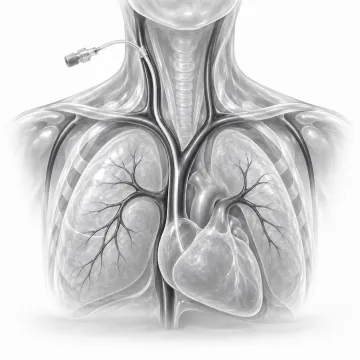
Central lines
PICC, tunneled line or port: how they differ and how to choose.
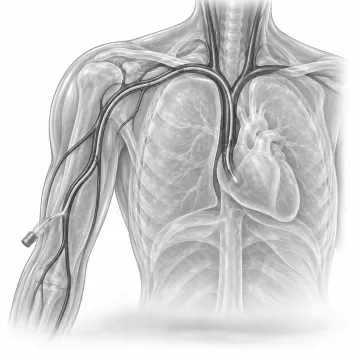
PICC lines
A thin arm line for weeks of IV antibiotics, nutrition or chemotherapy.
Palliative cancer care
Small procedures that ease fluid build-up, pain, blockages and eating problems caused by cancer.
Tunneled dialysis catheters
A soft tube in the chest that allows hemodialysis the same day it is placed.
Written for patients by the Palo Alto Interventional team. General information only; your own plan depends on your health and imaging.
Talk to us about your options
Request a consultation online, or call 650-404-8445, Monday to Friday, 8 am to 5 pm. You can also ask your doctor to send a referral. We will review your imaging and help you decide whether a procedure makes sense.