
PICC lines
Weeks of IV treatment, at home, with one line.
A PICC line is a thin, soft tube placed in a vein in your upper arm, with its tip near your heart. Placement takes about 15 minutes with local numbing, and you can go home and use it the same day.
- Outpatient
- About 15 minutes
- Local numbing
- Usable the same day
 Fabio Komlos, MDInterventional radiologist
 Watch the video explanation23:01 video · What You Need to Know About Central Lines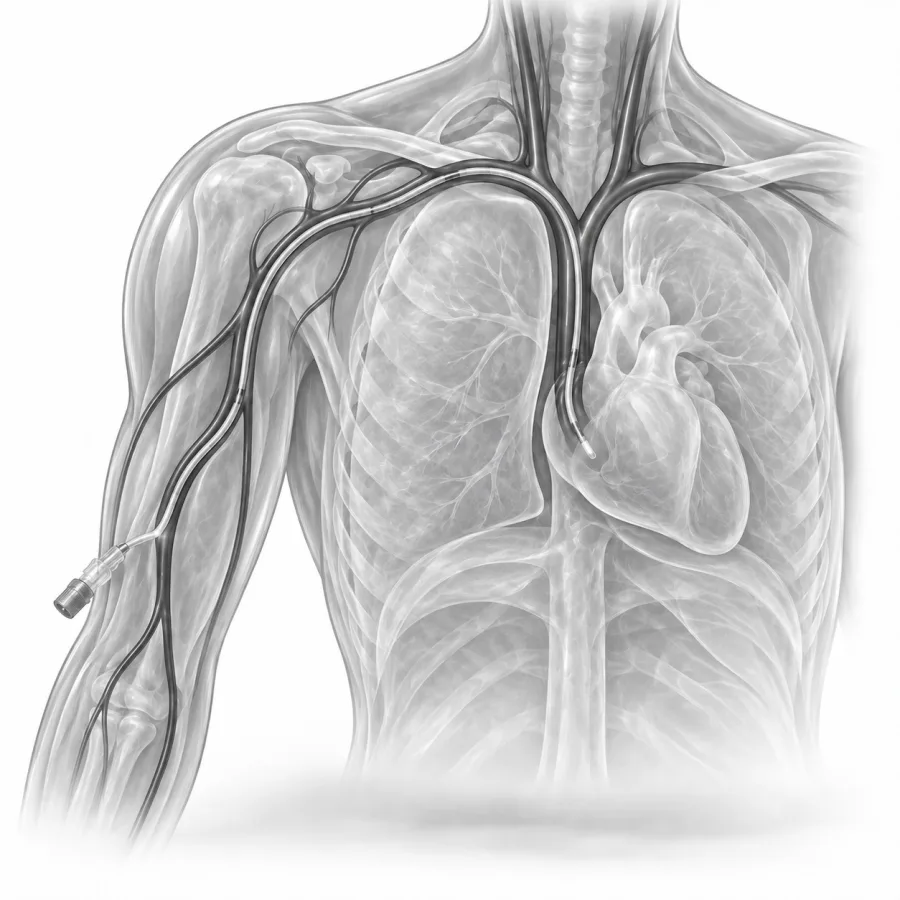
One line for weeks of treatment, placed through a pinhole.
What You Need to Know About Central Lines
Dr. Fabio Komlos walks through picc lines the way he explains it in clinic, using the same images he uses to plan treatment.
Fabio Komlos, MDInterventional radiologist · 23:01Central Lines 101 PICC, Tunneled Lines — Ports Explained
3:57
How to Flush a Catheter Correctly?
5:54
How to Take Care of Your Central Line
2:58
Quick answers
Under a minute eachWhat is a PICC line?
PICC stands for peripherally inserted central catheter. Peripherally inserted means it goes in through a vein in the arm rather than the neck or chest. Central means its tip sits in the large vein that enters the heart, where blood flow is fast enough to dilute strong medicines right away.
The PICC is about as thin as a strand of spaghetti. It enters a vein on the inside of your upper arm, above the elbow, and has one or two ends, called lumens, that stay outside the skin. It is held in place by a small adhesive securing device and covered with a clear dressing.
On the X-ray, the PICC appears as a thin white line running up the arm, across the shoulder and down into the chest, with its tip ending where the large vein meets the heart.
Who needs a PICC
A PICC is used when you need IV treatment for weeks to a few months: long courses of antibiotics, IV nutrition, some types of chemotherapy, or medicines that irritate small veins. It also lets you go home and have treatment there, which you cannot do with a regular IV, and it saves you from repeated needle sticks for IVs and blood draws.
A PICC is often best when
- You need IV treatment for about 1 week to 3 months
- You will receive treatment at home or at an infusion center
- Your hand and arm veins are hard to use for regular IVs
Another option may be better if
- You have chronic kidney disease or may need dialysis (a PICC can damage the arm veins needed for a fistula)
- You need treatment for many months (a port is often better)
- You have had clots in the arm veins
- You swim or cannot keep an arm line dry
For a side-by-side look at PICCs, tunneled lines and ports, see central lines.
How to prepare
- You can usually eat and drink normally, since a PICC is placed with local numbing and no sedation. We will tell you if your case is different.
- Tell us about blood thinners, allergies, and any history of kidney disease, clots, or a mastectomy or lymph node surgery on one side.
- Tell us which arm you use most. We usually place the PICC in your non-dominant arm.
- Wear a short-sleeved or loose top.
- If you will care for the line at home, bring a family member or caregiver to learn with you.
What happens during placement
The procedure is done at El Camino Hospital in the interventional radiology department, with a nurse, a radiology technologist and your interventional radiologist. You lie on your back with your arm stretched out to the side.
- 1Find the best vein
We look at the veins in your upper arm with ultrasound and choose one that is large enough. A tight band may be placed around the arm to make the vein bigger.
- 2Clean and numb
The arm is cleaned and covered with sterile drapes. We numb a small spot of skin, which stings for a few seconds.
- 3Place the line
Using ultrasound, we pass a small needle into the vein and a soft guidewire toward the heart, checking the path on X-ray. The PICC is slid over the wire and trimmed so its tip sits at the entrance to the heart. You may feel pressure, but not pain.
- 4Secure and dress
We confirm the tip position on X-ray, flush the line, and fix it with an adhesive securing device, a small antimicrobial sponge disc at the entry point, and a clear dressing.
Placement usually takes about 15 minutes. Afterward, a nurse reviews how to care for the line, which takes about 30 minutes, and then you can go home. You can drive, since there is no sedation.
Caring for your PICC at home
Good care is the best way to prevent infection and clots. A home infusion nurse or your infusion center usually changes the dressing and replaces the cap on the end of the line, called the needleless connector, once a week. Our flushing video shows the steps.
Every day
- Wash your hands before touching the line or dressing.
- Look at the site. Check that the dressing is clean, dry and sealed on all edges.
- Keep the ends clamped and capped when not in use, and tape or cover them so they do not snag.
- Use your arm normally for light daily tasks, but avoid lifting more than about 10 pounds, repeated overhead motion, and exercise that strains the arm, such as weightlifting or golf.
- No blood pressure cuffs or blood draws in the PICC arm, except through the PICC by trained staff.
Flushing
- 1Wash your hands and gather prefilled saline syringes, usually 10 mL.
- 2Scrub the connector with an alcohol or chlorhexidine pad for about 15 seconds and let it dry.
- 3Push the saline in short bursts, pause, push, pause, rather than one long push.
- 4Never force a flush. If it resists, stop and call your nurse or us.
- 5Follow your nurse's exact plan for how often to flush and whether to use a heparin lock.
Showering
- You can shower the day of placement if you keep the line dry.
- Cover the dressing with a waterproof sleeve or plastic wrap sealed with tape, and keep the arm out of the spray.
- If the dressing gets wet underneath, have it changed that day.
- No swimming, baths or hot tubs while the PICC is in.
If the PICC is pulled partway out, do not push it back in. Tape it in place and call. If it comes all the way out, press firmly on the site for 10 minutes, cover it with a bandage, and call us.
Risks
- Blood clot in the arm vein around the PICC, the most common complication. Signs are arm swelling, aching or a heavy feeling. It is usually treated with blood thinners, and sometimes the PICC is removed. See DVT and blood clots.
- Infection at the skin or in the bloodstream. The risk rises the longer the PICC stays in.
- Blockage of the line, often cleared with a clot-dissolving medicine.
- The line moving or being pulled out.
- Bleeding or bruising at the entry site, usually minor.
Before I place a PICC, I always ask about the kidneys, because the arm veins we use for a PICC are the same veins a surgeon needs to build a dialysis fistula. If your kidneys are weak, I will usually suggest a different line. For everyone else, I choose the smallest catheter that will do the job, since a thinner line leaves more room for blood to flow around it and lowers the chance of a clot.Fabio Komlos, MD, interventional radiologist · About Dr. Fabio Komlos
Removal
A PICC should come out as soon as you no longer need it, to avoid unnecessary infection and clots. Removal takes only a minute and does not need a procedure room. A nurse or doctor removes the dressing and securing device, gently pulls the line out, and presses on the site for about 5–10 minutes, then applies a bandage.
It does not hurt. Keep the bandage on and the site dry for 24 hours. Call us at 650-404-8445 if you need help arranging removal.
Common questions
Does it hurt to have a PICC placed?
How long can a PICC stay in?
Can I shower with a PICC?
Can I drive?
Can I have a CT scan with contrast through my PICC?
Why did the doctor suggest a port or tunneled line instead?
Will insurance cover a PICC?
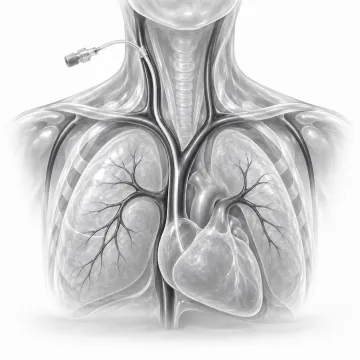
Central lines
PICC, tunneled line or port: how they differ and how to choose.
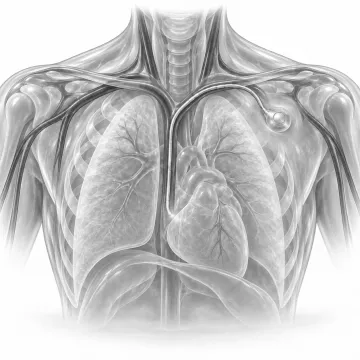
Ports
A small device under the chest skin for chemo, infusions and blood draws.
DVT (deep vein blood clots)
Blood clots in the leg or arm: signs, blood thinners, clot removal and long-term care.
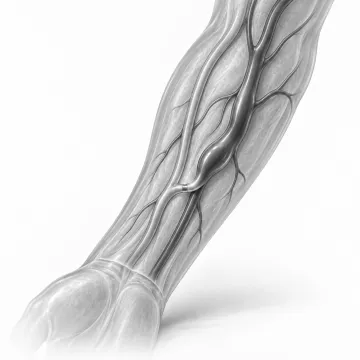
Understanding your dialysis access
Fistula, graft, catheter or PD: how each works, daily checks and warning signs.
Written for patients by the Palo Alto Interventional team. General information only; your own plan depends on your health and imaging.
Talk to us about your options
Request a consultation online, or call 650-404-8445, Monday to Friday, 8 am to 5 pm. You can also ask your doctor to send a referral. We will review your imaging and help you decide whether a procedure makes sense.