
Portal vein embolization
Grow your healthy liver before liver surgery.
Portal vein embolization (PVE) redirects blood flow inside the liver so the part that will remain after surgery grows larger and stronger. It is done through a needle puncture in the right side, and most people go home the same day or the next.
- Same day or 1 night
- 1–2 hours
- Sedation
- Surgery in 3–6 weeks
 Fabio Komlos, MDInterventional radiologist
 Watch the video explanation5:43 video · How Interventional Radiologists Treat Liver Tumors Without Surgery — at is liver-directed therapy?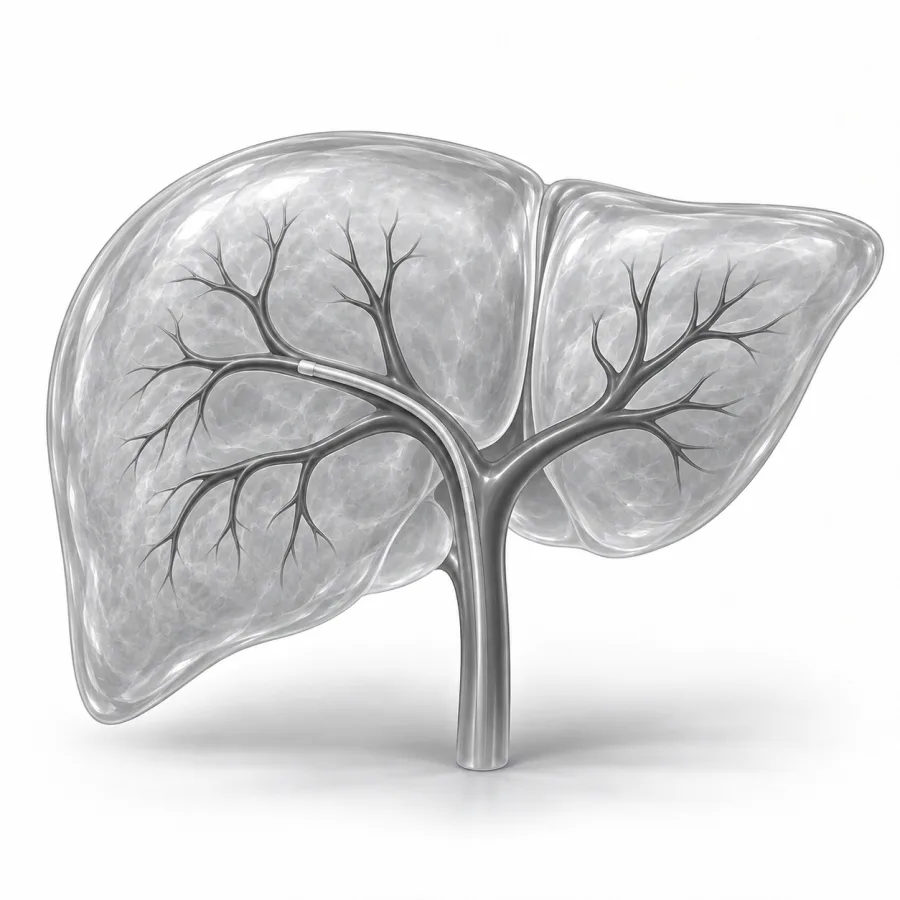
Grows the liver you will keep, before the operation.
How Interventional Radiologists Treat Liver Tumors Without Surgery — at is liver-directed therapy?
Dr. Fabio Komlos walks through portal vein embolization the way he explains it in clinic, using the same images he uses to plan treatment.
Fabio Komlos, MDInterventional radiologist · 5:43After Embolization? Don't Make These 5 Mistakes
5:32
Quick answers
Under a minute eachWhy the liver sometimes needs to grow before surgery
Surgery to remove part of the liver, called a liver resection or hepatectomy, is often the best chance to cure liver tumors. These can be cancers that start in the liver or cancers that have spread there, for example from the colon. The liver can regrow after surgery, but only if enough healthy liver is left behind to keep you well in the meantime.
The part of the liver that will stay after surgery is called the future liver remnant. Surgeons usually want it to be at least about 20 to 25 percent of your total liver if the liver is healthy, about 30 percent if it has been affected by chemotherapy or fatty liver, and about 40 percent if there is scarring (cirrhosis). If the remnant is too small, there is a higher risk of liver failure after surgery.
The liver has two blood supplies. The portal vein brings about three quarters of its blood from the intestines, and the hepatic artery brings the rest. In portal vein embolization (PVE), an interventional radiologist, a doctor who uses imaging to guide needles and thin tubes, blocks the portal vein branches going to the part of the liver that will be removed. Blood is redirected to the part that will stay, which responds by growing, usually over a few weeks.
Who PVE is for
PVE is planned together with your liver surgeon and oncologist. It is usually recommended after a CT or MRI scan shows that the future liver remnant is too small for a safe operation.
Often recommended when
- A large part of the liver needs to be removed
- The remaining liver is expected to be too small on the planning scan
- The liver has been affected by chemotherapy, fatty liver or mild scarring
- Your surgeon and oncologist agree surgery is the goal
May not be right if you have
- Advanced cirrhosis or poor liver function
- A blocked portal vein or a large clot in it
- Cancer that has spread outside the liver in a way that rules out surgery
- Uncontrolled bleeding problems
- Poorly controlled diabetes or kidney failure, which can limit growth
Before PVE, I sit down with the CT or MRI and measure the liver segment by segment, so I know exactly how much will remain and how much it needs to grow. I also look closely at the portal vein branches, because every liver is wired a little differently. I tell patients that this is a step toward surgery, not the treatment itself, and I work closely with their surgeon on the timing.Fabio Komlos, MD, interventional radiologist · About Dr. Fabio Komlos
How PVE compares with other approaches
PVE is the most established way to grow the liver before surgery. Depending on your situation, your team may also consider other strategies.
| PVE | PVE plus hepatic vein embolization | Two-stage surgery or ALPPS | |
|---|---|---|---|
| What it involves | Blocks portal vein branches | Also blocks the vein that drains that part of the liver | Surgery in two steps, days to weeks apart |
| Done by | Interventional radiologist | Interventional radiologist | Liver surgeon |
| Anesthesia | Sedation | Sedation or general | General, twice |
| Liver growth | Moderate, over weeks | Faster and larger in studies | Fastest |
For some tumors, radiation delivered through the arteries, called Y-90 radioembolization, can both treat the tumor and help the rest of the liver grow over a longer time. Your team will explain which approach fits your case.
How to prepare
- You will have blood tests, including tests of clotting, a few days before.
- Tell us about all your medicines. Blood thinners usually need to be paused. See blood thinners and procedures.
- Do not eat or drink after midnight, or for at least 8 hours before. Take your morning medicines with a small sip of water unless told otherwise.
- Tell us if you have had a reaction to contrast dye, or have kidney disease or diabetes.
- Plan for an adult to drive you home, and for the chance of staying one night.
- Leave jewelry and valuables at home.
What happens on the day
PVE is done at El Camino Hospital. When you arrive, a nurse helps you change into a gown, checks your vital signs, starts an IV and gives you fluids and medicines, which may include an antibiotic and an anti-nausea medicine.
- 1Getting comfortable
You lie on the procedure table and are connected to heart, blood pressure and oxygen monitors. You receive moderate sedation through your IV so you are relaxed and drowsy. The skin on your right side or upper belly is cleaned and numbed, which stings for a few seconds.
- 2Reaching the portal vein
Using ultrasound, the doctor guides a thin needle through the skin into a branch of the portal vein inside the liver. A thin catheter is then passed in, and contrast dye shows the portal vein branches on X-ray and measures the pressure inside them.
- 3Embolization
Tiny particles, and often small metal coils or a medical glue, are placed in the branches going to the part of the liver that will be removed. You may feel some pressure or ache in the right upper belly or shoulder.
- 4Closing the track
As the catheter is removed, the small track through the liver is sealed with a plug or coils to lower the risk of bleeding. A small bandage covers the skin. The procedure usually takes 1 to 2 hours.
On the portal venogram, the portal vein branches look like a tree spreading through the liver. After embolization, the branches to the part being removed no longer fill with contrast, while those to the part that will stay are fuller.
Recovery and what comes next
Afterward you rest in the recovery area for a few hours while the nurses check your vital signs and the puncture site. You can eat, drink and see your family. Many people go home the same day; some stay one night for observation and pain control.
- Day of the procedureRest. No driving, alcohol or important decisions for the rest of the day. You may shower tonight, but do not soak the site in a bath or pool for 1 week.
- First weekTake it easy. Dull ache in the right upper belly, pain in the right shoulder, mild fever, nausea and tiredness are common. No heavy lifting, exercise or strenuous activity for 7 days. You can drive the day after, if you are not taking strong pain medicine.
- 7 to 10 daysMost people feel back to normal.
- About 2 weeksFollow-up visit to check how you are recovering.
- 3 to 6 weeksA CT or MRI measures how much the future liver remnant has grown. If it is large enough, surgery is scheduled.
Pain relief
- Acetaminophen (Tylenol) helps with mild discomfort. Ask us before taking ibuprofen or other anti-inflammatory medicines before liver surgery.
- Pain in the right shoulder is a normal referred pain from the liver.
- Pain should slowly get better. Pain that is severe or getting worse may be a sign of bleeding.
Results and risks
In published studies, the future liver remnant usually grows by about 30 to 40 percent of its original size within 3 to 6 weeks, and most people who have PVE go on to surgery. In some people, roughly 1 in 10 to 1 in 5, the liver does not grow enough or the cancer grows during the wait, and surgery is not possible. Your team will keep you informed at each step.
Possible risks
- Bleeding from the liver or the puncture site, which is uncommon; we check your blood clotting before and seal the track at the end
- Particles or coils moving into branches of the portal vein that feed the healthy liver, which we guard against by watching every injection on X-ray
- A clot in the main portal vein, which is rare
- Infection or an abscess in the liver, which is rare
- Air or bile leaking near the liver, which is rare
- Reaction to contrast dye or effects on the kidneys, especially if you have diabetes or kidney disease
Common questions
Is PVE a treatment for my cancer?
Does it hurt?
How long until surgery?
Will I stay in the hospital?
Can I keep having chemotherapy?
What if my liver does not grow enough?
When can I drive and go back to work?
Liver tumors
Primary liver cancer and liver metastases: what they are and every way to treat them.
Y-90 radioembolization
Tiny radioactive beads treat liver tumors from inside, with two short outpatient visits.
Chemoembolization (TACE)
Concentrated chemotherapy and a blocked blood supply, aimed right at a liver tumor.
Tumor ablation
Heat or freeze a tumor through a needle, with no incision and a short recovery.
Embolization
Block selected blood vessels from the inside to stop bleeding, shrink growths or ease pain.
Written for patients by the Palo Alto Interventional team. General information only; your own plan depends on your health and imaging.
Talk to us about your options
Request a consultation online, or call 650-404-8445, Monday to Friday, 8 am to 5 pm. You can also ask your doctor to send a referral. We will review your imaging and help you decide whether a procedure makes sense.