
Pelvic congestion syndrome
Relieve chronic pelvic pain caused by swollen veins.
Pelvic congestion syndrome is long-lasting pelvic pain caused by enlarged, leaky veins around the ovaries and uterus. Ovarian vein embolization closes those veins through a pinhole, and most women go home the same day.
- Often missed
- Worse when standing
- Outpatient treatment
- Home the same day
 Fabio Komlos, MDInterventional radiologist
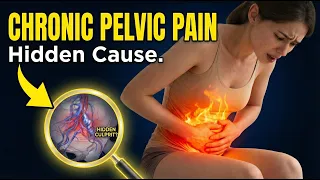 Watch the video explanation13:12 video · Pelvic Congestion Syndrome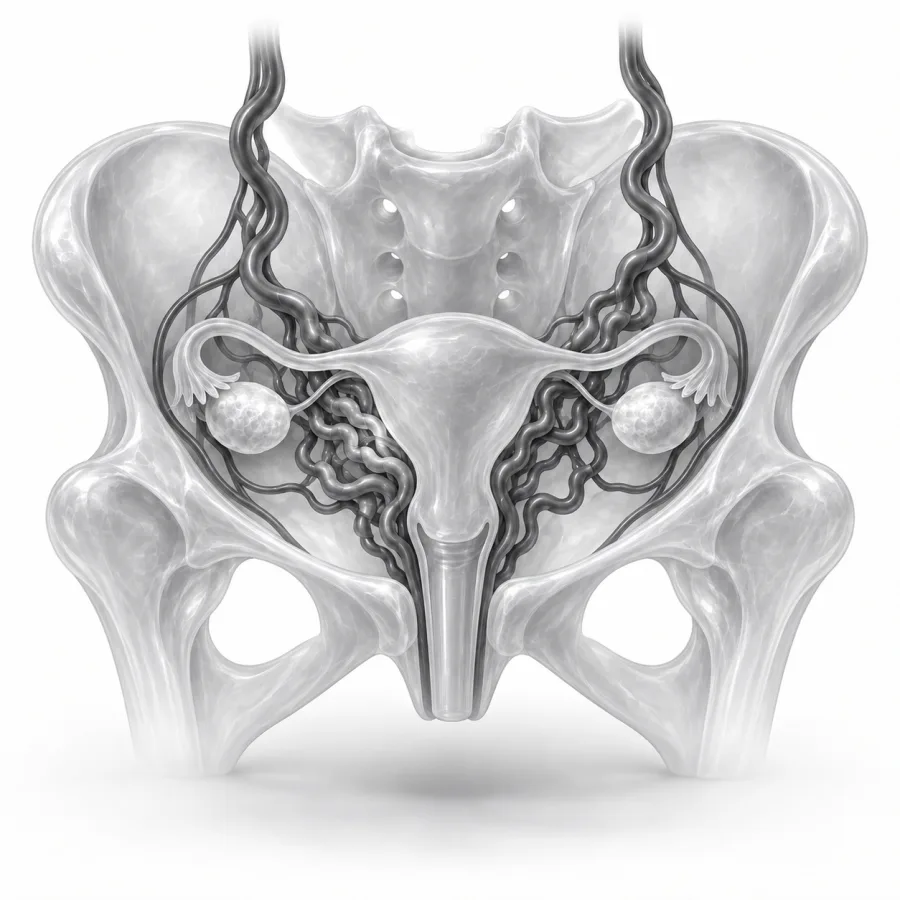
Treated through a small vein in the neck, arm or groin.
Pelvic Congestion Syndrome
Dr. Fabio Komlos walks through pelvic congestion syndrome the way he explains it in clinic, using the same images he uses to plan treatment.
Fabio Komlos, MDInterventional radiologist · 13:12Ever heard of May-Thurner Syndrome? Most people havent but its a major cause of blood clots in th
3:27
Quick answers
Under a minute eachWhat is pelvic congestion syndrome?
Pelvic congestion syndrome (PCS) is chronic pelvic pain caused by varicose veins in the pelvis. The veins that drain the ovaries and uterus have one-way valves, like the veins in your legs. When those valves weaken, blood flows backward and pools. The veins stretch and swell, much like varicose veins in the legs, and the congestion causes a dull, heavy ache.
The veins most often involved are the ovarian veins, also called gonadal veins, especially the left one. Branches of the internal iliac veins deeper in the pelvis can be involved too.
Who is most likely to have it
- Women of childbearing age, usually between about 20 and 50
- Women who have been pregnant, especially more than once, since pregnancy stretches the pelvic veins
- Women with varicose veins in the legs, vulva or buttocks
- Sometimes, women whose pelvic veins are squeezed by an artery, such as in May-Thurner syndrome or nutcracker syndrome, where the left kidney vein is compressed
Symptoms
The main symptom is pelvic pain lasting more than 6 months. It is usually a dull ache or heaviness rather than a sharp pain, and it has a typical pattern.
- Pain that gets worse through the day, after standing or sitting for a long time
- Pain that eases when you lie down
- Deep pain during or after sex
- Pain that worsens around your period or during pregnancy
- Varicose veins on the vulva, upper inner thighs or buttocks
- A feeling of needing to urinate often, or low back ache
- Pain that may be on one side or both
Many women with PCS see several doctors over years before the diagnosis is made. Pelvic pain has many possible causes, and pelvic veins are easy to miss because they often shrink when you lie down for a scan.
How it is diagnosed
Diagnosis starts with ruling out other causes of pelvic pain, such as endometriosis, fibroids, ovarian cysts, infection and bowel or bladder conditions. This is usually done with your gynecologist. Then we look at the veins.
- 1Pelvic ultrasound with Doppler, often through the vagina, looks for enlarged veins and backward flow. It is best done while you strain or stand, when the veins fill.
- 2CT or MRI can show enlarged pelvic veins and look for compression of the kidney or iliac veins.
- 3Venogram. Contrast dye is injected into the veins through a thin tube to show the reflux directly. This is the most accurate test and is usually done at the start of treatment.
On the venogram, dye injected into a healthy ovarian vein flows up toward the heart. In pelvic congestion, the dye flows backward down a widened ovarian vein and fills a cluster of twisted veins around the uterus, sometimes crossing to the other side of the pelvis.
Treatment options
Treatment is aimed at relieving pain. If your symptoms are mild, pain medicine may be enough. If pain affects your daily life, work or relationships, closing the leaky veins is often the most effective option.
| Medicines | Ovarian vein embolization | Surgery | |
|---|---|---|---|
| What it involves | Anti-inflammatory pain relievers or hormone treatment that shrinks the veins | The leaky veins are closed from inside through a pinhole | Tying off veins, or removing the uterus and ovaries |
| Anesthesia | None | Moderate sedation | General anesthesia |
| Recovery | None | Usually 2–5 days | Weeks |
| Trade-offs | Relief often stops when medicine stops; hormone side effects | Pain relief builds over weeks to months; not all women improve | More invasive; hysterectomy ends fertility |
Ovarian vein embolization is the most common procedure for PCS. It uses small metal coils, sometimes with a foam medicine called a sclerosant, to block the faulty veins. Blood then drains through other, healthy veins. Published studies report that roughly 3 in 4 women have meaningful pain relief.
Embolization may suit you if
- You have typical PCS pain for more than 6 months
- Imaging shows enlarged pelvic veins with reflux
- Other causes of pain have been checked
- You want to avoid surgery or keep your uterus
It may not be right if
- You are pregnant
- Your pain pattern points to another cause
- You have a serious allergy to contrast dye that cannot be managed
- An uncorrected vein compression is the main problem, which may need a different treatment such as a stent
What embolization is like, step by step
- 1Get comfortable
You change into a gown and an IV is placed. You receive moderate sedation, which keeps you relaxed and drowsy while you breathe on your own.
- 2Enter a vein
We numb the skin at the neck, arm or groin and place a thin tube into a vein using ultrasound. The tube is guided into the pelvic veins with X-ray, and dye maps the leaky veins.
- 3Close the veins
We place small coils along the leaky ovarian vein and may inject foam into the swollen veins around the uterus. The coils stay in place permanently and cannot be felt.
- 4Finish and recover
The tube is removed and pressure is applied. There are no stitches. You rest for a few hours and go home the same day.
The procedure usually takes 1 to 2 hours. Some women need both sides treated, and a few need a second session.
Recovery, results and risks
- First 1–3 daysPelvic cramping, back or flank ache is common. Anti-inflammatory pain relievers usually control it. Rest, and avoid heavy lifting.
- Within a weekMost women are back at work and normal activity within 2 to 5 days.
- Weeks to monthsPain relief builds gradually as the veins shrink. Many women notice a clear change over 1 to 3 months.
- Follow-upA clinic visit to check how you are doing. If pain continues, we may look for other veins that need treatment.
Possible risks
- Pain and cramping for a few days
- Bruising at the puncture site
- Inflammation of a treated vein, called phlebitis, causing tenderness for a week or two
- Rarely, a coil moving out of place, which can usually be retrieved
- Pain may not improve, or may return over time
- A small dose of X-ray radiation to the pelvis, kept as low as possible
Many of the women I see with pelvic congestion have been told for years that their pain is in their head or just part of being a woman. When I watch the dye flow backward into a web of swollen veins on the venogram, it is often a relief for them to finally see the cause. I am honest that not everyone improves, but for the right patient, closing those veins can give back comfortable days.Fabio Komlos, MD, interventional radiologist · About Dr. Fabio Komlos
Common questions
Will embolization affect my fertility or periods?
Does it hurt?
How soon will I feel better?
Is it safe to close these veins?
Will it also help my vulvar or leg varicose veins?
Will insurance cover it?
Can men get pelvic congestion?
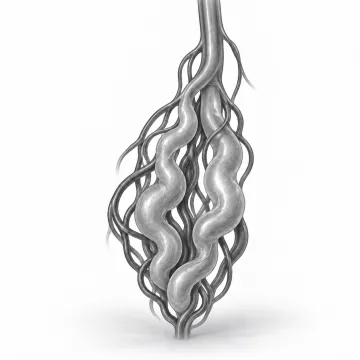
Varicocele
Swollen veins in the scrotum: symptoms, fertility effects, and surgery vs embolization.
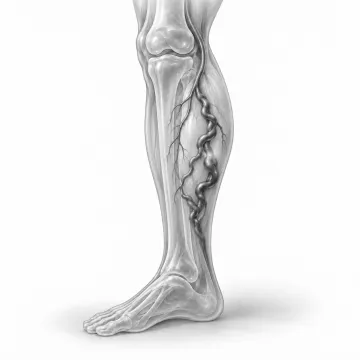
Varicose veins
Why leg veins bulge and ache, and how to treat them without major surgery.
Uterine fibroid embolization
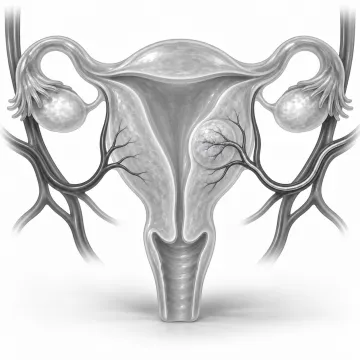
Shrink fibroids through a pinhole, without removing the uterus or a large incision.
DVT (deep vein blood clots)
Blood clots in the leg or arm: signs, blood thinners, clot removal and long-term care.
Written for patients by the Palo Alto Interventional team. General information only; your own plan depends on your health and imaging.
Talk to us about your options
Request a consultation online, or call 650-404-8445, Monday to Friday, 8 am to 5 pm. You can also ask your doctor to send a referral. We will review your imaging and help you decide whether a procedure makes sense.