
Sacroplasty
Relieve the pain of a sacral fracture and walk again.
Sacroplasty strengthens a cracked sacrum, the bone at the base of the spine, by injecting medical bone cement through a needle. It takes about an hour, and many people walk with less pain within days.
- Outpatient
- About 1 hour
- Sedation
- Home the same day
 Fabio Komlos, MDInterventional radiologist
 Watch the video explanation9:27 video · Kyphoplasty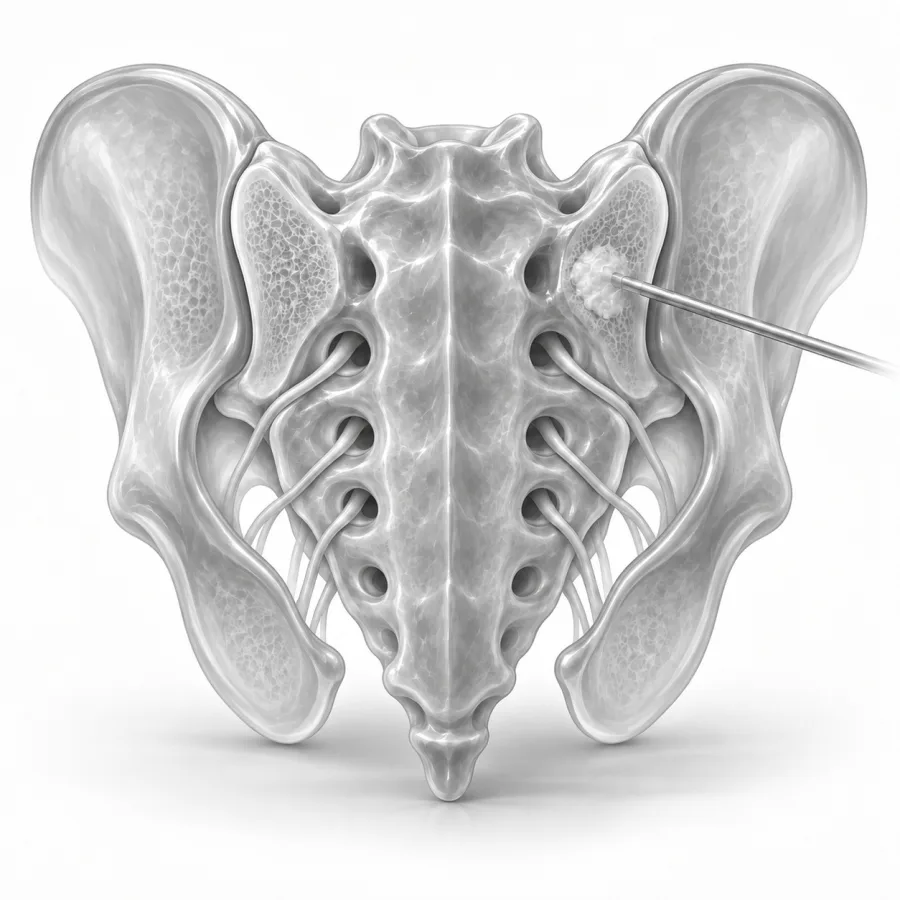
Small needle punctures, sealed with skin glue.
Kyphoplasty
Dr. Fabio Komlos walks through sacroplasty the way he explains it in clinic, using the same images he uses to plan treatment.
Fabio Komlos, MDInterventional radiologist · 9:27What is a sacral insufficiency fracture?
The sacrum is the large, shield-shaped bone at the bottom of the spine, between the two hip bones. It carries the weight of the upper body into the pelvis and legs. When the bone is weak, everyday stress such as walking or stepping off a curb can crack it. This is called a sacral insufficiency fracture.
Who gets them
- Older adults with osteoporosis, most often women over 70.
- People who have had radiation to the pelvis for cancer of the cervix, uterus, prostate, rectum or bladder.
- People on long-term steroid medicines, or with rheumatoid arthritis.
- People with cancer that has spread to the sacrum, or myeloma.
The fracture causes deep pain in the low back, buttocks, hips or groin, worse when standing or walking and better lying down. Because the pain is vague, it is often mistaken for arthritis, a slipped disc or a hip problem. Regular X-rays miss most of these fractures.
On MRI, the fracture shows as bright swelling along one or both sides of the sacrum. On a bone scan, fractures on both sides with a bar across the middle can form an H shape, a classic sign. CT shows the thin fracture lines and helps plan the needle path.
What is sacroplasty?
Sacroplasty is similar to kyphoplasty for spine fractures. Using CT or live X-ray, the doctor guides one or more needles into the cracked areas of the sacrum and slowly injects medical-grade bone cement (PMMA). The cement hardens within minutes and supports the bone from inside, so the broken edges stop moving. That movement is what causes most of the pain.
Sacroplasty has been studied more than ramiplasty but less than kyphoplasty. Large observational studies show fast and lasting pain relief, but there are no large randomized trials comparing it with a sham procedure yet.
Who it helps, and who it doesn't
Many sacral fractures heal with rest, pain medicine, physical therapy and a walker, but healing can take 3 to 6 months or longer. During that time, older adults can lose strength, fall, develop blood clots or pneumonia, and lose independence. Sacroplasty aims to shorten that painful period.
Good candidates
- A sacral fracture confirmed on MRI or CT
- Pain that keeps you from walking or caring for yourself
- Pain that has not improved enough after a few weeks of standard care
- Pain medicines cause confusion, falls or constipation
- Painful sacral fractures from cancer or after pelvic radiation
May not be right if
- Your pain is steadily improving with standard care
- The pain comes mainly from another problem, such as the hip or spine
- The fracture is displaced or the pelvis is unstable, which may need surgery
- You have an infection in the bone, skin or elsewhere in the body
- You have a bleeding problem that cannot be corrected
How it compares with other options
| Sacroplasty | Standard care | Surgical fixation | |
|---|---|---|---|
| What it involves | Cement through needles | Pain medicine, walker, physical therapy | Screws placed by a surgeon |
| Anesthesia | Sedation or general | None | General |
| Time to walking comfortably | Often days | Often months | Weeks |
| Hospital stay | Usually none | Sometimes, if pain is severe | Usually a few days |
A newer surgical option places screws across the sacrum through small incisions, sometimes combined with cement. It is generally used for less stable fractures. For cancer, radiation therapy is often part of the plan. Standard care also always includes treating osteoporosis.
How to prepare
- You will need recent imaging, usually MRI and CT of the pelvis.
- Tell us about blood thinners. Most need to be stopped for a set number of days. See blood thinners.
- Nothing to eat or drink after midnight. Take approved morning medicines with a small sip of water.
- Leave jewelry and valuables at home.
- Arrange an adult to drive you home and stay with you the first night.
More general advice is on before your procedure and sedation.
What happens during sacroplasty
- 1Preparing
You lie on your stomach on the CT or X-ray table. You receive sedation or general anesthesia and antibiotics through your IV. The skin over the lower back and buttocks is cleaned and numbed.
- 2Placing the needles
Using CT or live X-ray, the doctor guides one or two needles into each fractured side of the sacrum, carefully avoiding the openings where the nerves to the legs pass through.
- 3Injecting the cement
Bone cement is injected slowly while images check that it fills the fracture and stays inside the bone.
- 4Finishing
The needles are removed and the punctures are sealed with skin glue. The procedure usually takes about 1 hour.
You lie on your back for about 1 to 2 hours while the cement fully hardens. Nurses check your leg strength and feeling. Most people go home the same day, and those who were already in the hospital may stay longer.
Recovery and results
- First dayRest. Soreness at the needle sites is normal. Walk with help when you feel ready. No driving after sedation.
- First weekWalk several times a day with your walker or cane. Many people notice easier walking within a few days. Shower after 24 hours, but no baths or pools for 1 week.
- Weeks 2 to 6Continue physical therapy and slowly return to your normal routine. Your doctor may lower your pain medicines.
- Longer termMake a plan with your primary care doctor or endocrinologist to treat osteoporosis and prevent future fractures.
In published studies, including a large study that followed patients for 10 years, most people had a large drop in pain within the first days to weeks, and the relief lasted. Many were able to walk more and take fewer pain medicines. Results vary, and some people improve less.
Sacral fractures are one of the most missed causes of low back and buttock pain in older adults, especially after pelvic radiation. When I see a patient with this kind of pain, I look for the fracture lines on MRI or CT and make sure they match where it hurts. For someone who has gone from walking independently to barely getting to the bathroom, getting them moving again quickly can make a real difference.Fabio Komlos, MD, interventional radiologist · About Dr. Fabio Komlos
Risks
- Cement leaking outside the bone. Small leaks are fairly common and usually cause no symptoms. A leak into a nerve opening can irritate a nerve and cause leg pain, which is uncommon and often temporary.
- Soreness or bruising at the needle sites for a few days.
- Infection, rare.
- Bleeding, rare.
- Nerve injury causing lasting leg pain or weakness, rare.
- Cement traveling through a vein to the lungs, rare and usually without symptoms.
- No improvement, especially if pain comes from other fractures or problems.
- New fractures elsewhere, because the underlying bone weakness remains.
Common questions
Does sacroplasty hurt?
How soon will I feel better?
Why did my X-rays look normal?
Can other fractures be treated at the same time?
I had radiation for cancer years ago. Could that be the cause?
Will insurance cover it?
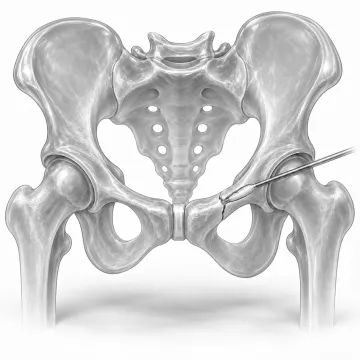
Ramiplasty
Stabilize a painful pubic bone fracture with bone cement, so walking hurts less.
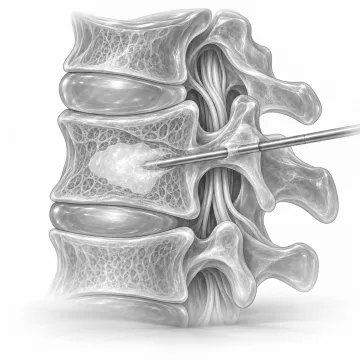
Kyphoplasty
Stabilize a painful spine compression fracture with bone cement, through a needle.
Cancer pain treatment
Nerve blocks, spine and bone procedures, and pain pumps for cancer pain medicines cannot control.
Palliative cancer care
Small procedures that ease fluid build-up, pain, blockages and eating problems caused by cancer.
Written for patients by the Palo Alto Interventional team. General information only; your own plan depends on your health and imaging.
Talk to us about your options
Request a consultation online, or call 650-404-8445, Monday to Friday, 8 am to 5 pm. You can also ask your doctor to send a referral. We will review your imaging and help you decide whether a procedure makes sense.