
Peripheral nerve stimulators
Calm stubborn pain in one area, without drugs.
Peripheral nerve stimulation places a wire thinner than a strand of spaghetti next to a painful nerve, using ultrasound or X-ray. A small wearable device sends gentle pulses, often for 60 days, and then the wire comes out.
- Outpatient
- 30–60 minutes
- Local numbing
- Home the same day
 Fabio Komlos, MDInterventional radiologist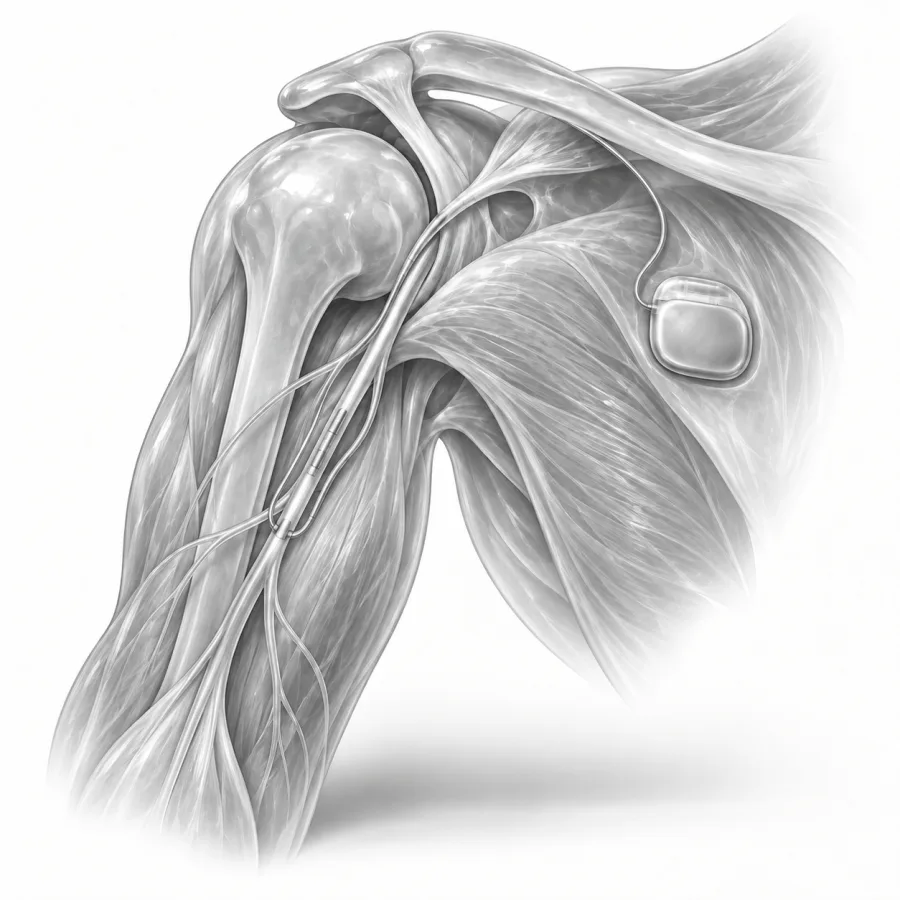
A needle places the wire, and it slides out later.
What is peripheral nerve stimulation?
Peripheral nerves are the nerves outside the spine and brain, running to your back muscles, shoulders, arms, legs and head. When one keeps sending pain signals, gentle electrical pulses near that nerve can change the signal so less pain reaches the brain. This is peripheral nerve stimulation (PNS).
Unlike a spinal cord stimulator, which works at the spinal cord, PNS works right at the nerve that serves the painful area. It is usually used for pain in one region, such as one shoulder, one knee or one side of the lower back.
Two main types
- Temporary (60-day) system: a very thin, coiled wire (lead) is placed through a needle and connected to a small stimulator stuck to the skin. After about 60 days, the lead is gently pulled out. In many people, relief continues for months after removal, possibly because the nervous system resets how it processes pain.
- Implanted system: a lead stays in place long term. Depending on the system, it is powered by a tiny implanted battery or by a wearable device outside the skin. This is an option when pain returns after a temporary treatment that worked well.
On ultrasound, the nerve looks like a small honeycomb-shaped oval, and the needle appears as a bright line approaching it. On X-ray, the thin lead shows up as a fine white coil.
Who it helps, and who it doesn't
May help with
- Chronic low back pain, by stimulating the nerves to the deep back muscles
- Ongoing pain after a knee replacement, or knee arthritis pain
- Chronic shoulder pain, including after a stroke
- Pain after an amputation, including phantom limb pain
- Pain from a nerve injury or scar, such as after surgery
- Headaches at the back of the head (occipital neuralgia)
May not be right if
- You have an infection or open wound near the site
- You have a pacemaker or defibrillator that cannot be managed safely with the device
- You need frequent MRI scans of that area and your device choice does not allow it
- You have severe skin sensitivity to adhesives that cannot be worked around
- Your pain is widespread rather than in one area
PNS can be tried when medicines, physical therapy or injections have not helped enough, and it is appealing to people who want to avoid more medicines or surgery. It is also an option for people who are not candidates for a spinal cord stimulator.
How it compares with other options
| Temporary PNS | Spinal cord stimulator | Nerve ablation | |
|---|---|---|---|
| Where it works | One nerve in the painful area | The spinal cord | One or a few small nerves |
| Permanent hardware? | No, removed at about 60 days | Yes, after a trial | No |
| Procedure | Needle placement, no incision | Trial, then surgical implant | Needle procedure with heat |
| Daily care | Wear and charge the device, keep site dry | Charge and adjust device | None |
| How long it lasts | Varies, often months after removal | Years while the device is used | Often 6 to 12 months |
Other options include nerve blocks, genicular nerve ablation for knee pain and epidural steroid injections for pain from the spine.
Getting ready
- Tell us about blood thinners. Many can be continued for leads placed near the surface, but we will give you specific instructions. See blood thinners.
- Tell us about any pacemaker, defibrillator or other implanted device, and any allergy to adhesives or tape.
- Most people need only local numbing. If you choose light sedation, do not eat or drink for about 6 to 8 hours beforehand and arrange a ride home.
- Think about where the wearable device will sit so it fits with your clothes, work and sleep. We will talk this through with you.
What happens during lead placement
- 1Mapping the target
You lie in a comfortable position. The doctor uses ultrasound or X-ray to find the nerve that serves the painful area, then cleans and numbs the skin.
- 2Testing
A thin needle is guided near the nerve. A mild test current is turned on, and you tell the doctor when you feel a comfortable tingling or muscle pulsing over your painful area.
- 3Placing the lead
The lead is released through the needle, and the needle is removed. The lead's tiny coil anchors it in the tissue. Sometimes a second lead is placed.
- 4Connecting the device
The lead exits the skin and is covered with a clear bandage. A small stimulator is clipped or stuck onto the skin nearby, programmed, and you are shown how to use it.
The procedure usually takes 30 to 60 minutes, and you go home shortly afterward. Implanted systems may need a small incision and take a little longer.
Life during treatment
- First few daysMild soreness where the lead enters the skin. Start using the stimulator as instructed, often for several hours a day or around the clock.
- Weeks 1 to 8Keep the bandage clean and dry. Sponge bathe, or cover the site carefully for a quick shower if you are told you can. No baths, hot tubs or swimming. Change batteries or charge the device as shown, and keep a pain log.
- Around day 60Clinic visit to remove the lead. The bandage is lifted and the lead is gently pulled out in seconds. A small bandage covers the spot.
- Months afterFollow-up to see whether relief has lasted. If pain returns after a treatment that worked, repeating it or an implanted system may be discussed.
Tips
- Avoid heavy lifting, strenuous stretching or rough activity that could pull on the lead.
- If the lead starts to come out, do not push it back in. Call us.
- Tell any doctor or imaging team you have a lead in place. MRI rules depend on the system, so ask before any scan.
Results and risks
In published studies of the 60-day system, many people with chronic back, shoulder or post-amputation pain had at least 50% less pain during treatment, and a good number still had meaningful relief months after the lead was removed. Results vary, and not everyone responds.
I like peripheral nerve stimulation for people whose pain lives in one clear area and who would rather not add another medicine. I use ultrasound to see the nerve directly, and during placement I ask you where you feel the tingling so we can match it to your pain. I tell patients that the temporary system is a real treatment, not just a test, and that the goal is relief that outlasts the wire.Fabio Komlos, MD, interventional radiologist · About Dr. Fabio Komlos
Possible risks
- Skin irritation or itching from the bandage, which is the most common problem.
- Infection where the lead enters the skin, uncommon, usually treated by removing the lead and sometimes antibiotics.
- The lead moving or coming out early, which may reduce relief.
- A tiny piece of the lead breaking off and staying under the skin when it is removed. This is usually harmless and rarely causes symptoms.
- Bleeding or bruising, uncommon.
- Nerve irritation or discomfort from the stimulation, usually fixed by changing settings.
Common questions
Does it hurt to have the lead placed?
Can I sleep and work with it?
Can I shower?
What happens if my pain returns after the lead is removed?
Is this the same as a TENS unit?
Will insurance cover it?
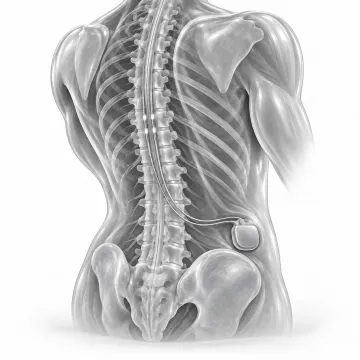
Spinal cord stimulators
Quiet chronic back, leg or nerve pain with a small implanted device you test first.
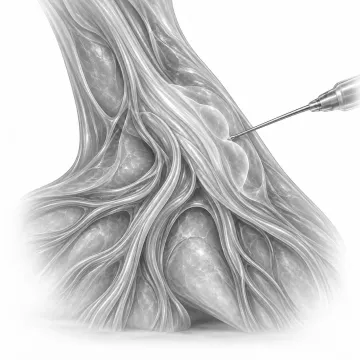
Nerve blocks
Pinpoint and calm the nerve carrying your pain with a precise, image-guided injection.
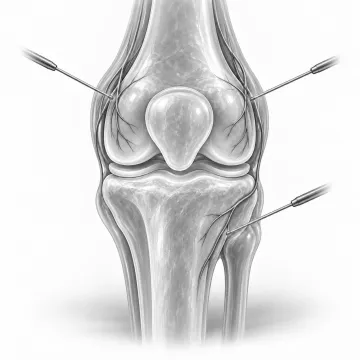
Genicular nerve ablation
Quiet the nerves that carry knee arthritis pain with a short needle procedure.
Epidural steroid injections
Ease sciatica, arm pain or back pain with a precise, image-guided steroid injection.
Written for patients by the Palo Alto Interventional team. General information only; your own plan depends on your health and imaging.
Talk to us about your options
Request a consultation online, or call 650-404-8445, Monday to Friday, 8 am to 5 pm. You can also ask your doctor to send a referral. We will review your imaging and help you decide whether a procedure makes sense.