
Genicular nerve ablation
Ease knee arthritis pain without surgery.
Genicular nerve ablation uses gentle heat to quiet the small nerves that carry pain from the knee. It takes under an hour through a few needle punctures, and relief often lasts 6 to 12 months or longer.
- Outpatient
- 30–60 minutes
- Local numbing
- Walk out the same day
 Fabio Komlos, MDInterventional radiologist
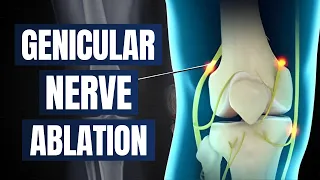 Watch the video explanation11:00 video · Genicular Nerve Ablation: When Injections Aren't Enough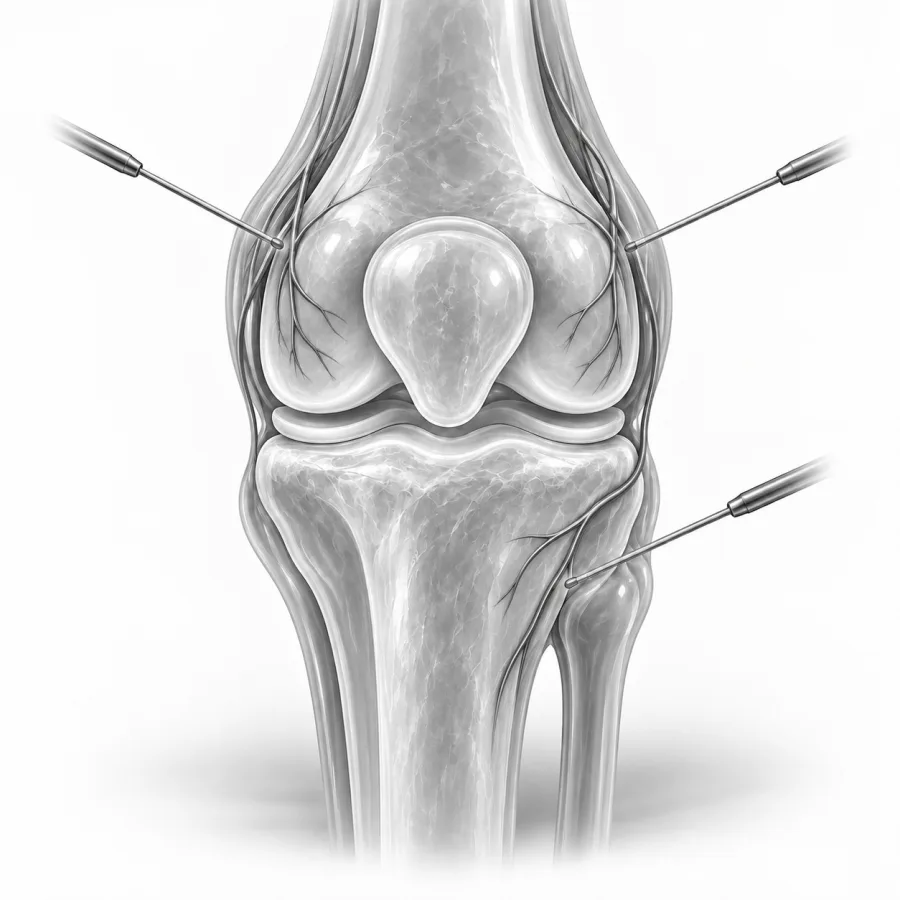
A few thin needles, and a small bandage afterward.
Genicular Nerve Ablation: When Injections Aren't Enough
Dr. Fabio Komlos walks through genicular nerve ablation the way he explains it in clinic, using the same images he uses to plan treatment.
Fabio Komlos, MDInterventional radiologist · 11:00Genicular Artery Embolization vs Nerve Ablation | Which Works Better?
6:46
Minimally invasive options for knee pain due to arthritis
5:01
Quick answers
Under a minute eachWhat is genicular nerve ablation?
Several small sensory nerves wrap around the knee, called the genicular nerves. They carry pain signals from the knee joint to the brain, but they do not control the muscles. When knee arthritis (osteoarthritis) causes constant pain, these nerves keep sending that signal.
In genicular nerve ablation, also called genicular radiofrequency ablation (RFA), the doctor places thin needles next to these nerves using X-ray or ultrasound. A probe at the tip heats the nerve with radio waves, usually to about 80 to 90°C for 1 to 3 minutes. This stops the nerve from sending pain signals for many months. Your knee still works the same way, and your leg muscles keep their strength.
The ablation treats the pain signal, not the arthritis itself. The nerves slowly grow back, so the pain may return after months to a couple of years. The treatment can be repeated.
On the X-ray image, the needle tips rest against specific points on the thigh bone and shin bone just above and below the joint, where the genicular nerves run along the bone.
Who it helps, and who it doesn't
Good candidates
- Knee arthritis pain for 3 months or more that limits walking, stairs or sleep
- Physical therapy, weight loss, pain medicines or knee injections no longer help enough
- You want to delay or avoid knee replacement, or you are not healthy enough for surgery
- Ongoing pain after a knee replacement, once other causes are ruled out
- Strong relief from a genicular nerve block test
May not be right if
- Your knee locks, gives way or is badly deformed, which may need surgery
- You have an infection in or around the knee
- Your pain comes from the back, hip or nerves in the leg rather than the knee
- You did not get clear relief from the test block
- You have a pacemaker or defibrillator that cannot be managed safely during treatment
How it compares with other options
Genicular nerve ablation fits between injections and knee replacement. Another option, genicular artery embolization (GAE), treats the same kind of knee pain in a different way: it blocks tiny abnormal blood vessels that feed inflammation in the knee lining, through a pinhole in an artery.
| Nerve ablation | Artery embolization (GAE) | Knee replacement | |
|---|---|---|---|
| What it targets | Pain nerves around the knee | Inflamed blood vessels in the knee lining | The worn joint itself |
| How it is done | Needles through the skin at the knee | Thin tube through an artery in the thigh | Open surgery |
| Sedation | Local numbing, light sedation if needed | Moderate sedation | General or spinal anesthesia |
| Recovery | 1 to 2 days | A few days | 6 to 12 weeks or more |
| How long it lasts | Often 6 to 12 months or longer, repeatable | 1 to 2 years in early studies | 15 to 20 years or more |
Steroid injections often help for a few weeks to a few months. Hyaluronic acid (gel) injections help some people. Knee replacement is a proven, lasting fix for severe arthritis, and choosing ablation does not stop you from having surgery later.
Step one: the test block
Before the ablation, you have a genicular nerve block. It uses the same needle positions, but only numbing medicine, and takes about 15 minutes. If your knee pain drops by about half or more for the few hours the medicine lasts, the ablation is likely to help. Try the activities that usually hurt, such as walking or stairs, and write down your pain score every hour.
Some practices and insurance plans use one test block, others two. Learn more about blocks on our nerve blocks page.
Getting ready
- Tell us about blood thinners. For knee procedures, many can be continued, but we will give you specific instructions. See blood thinners.
- Tell us if you have a pacemaker, defibrillator, spinal cord stimulator or other implanted device, or metal in the knee.
- If you will have sedation, do not eat or drink for about 6 to 8 hours beforehand.
- Wear loose shorts or pants that roll up easily above the knee.
- Arrange a ride home.
What happens during the ablation
- 1Positioning
You lie on your back with a pillow under the knee. A grounding pad is placed on your thigh or back. The skin is cleaned and numbed.
- 2Placing and testing the needles
Using X-ray or ultrasound, the doctor places 3 to 5 thin needles next to the nerves. A mild electrical test confirms each needle is near a sensory nerve and away from nerves that move your leg.
- 3Treating the nerves
More numbing medicine goes through each needle. The tips are then heated for about 1 to 3 minutes each. You may feel warmth or pressure.
- 4Finishing
The needles are removed and small bandages applied. You rest for about 30 minutes, then walk out.
Recovery and results
- First dayThe knee may feel numb from the medicine. Walk as you feel able. Ice for 15 to 20 minutes at a time helps soreness. No driving if you had sedation.
- Days 2 to 7Most people are back to normal activity. Some soreness or a sunburn-like feeling around the knee is common and fades.
- 2 to 4 weeksThe full effect usually appears. Pain often gets better gradually rather than all at once.
- 6 to 12 months or longerRelief may slowly fade as the nerves regrow. If the first treatment helped, it can usually be repeated.
In published studies, most people who had a good test block have meaningful pain relief at 6 months, and many still do at 1 year. Walking, stairs and sleep often improve. Results vary, and some people get little benefit.
Many of my patients with knee arthritis are caught between injections that no longer last and a knee replacement they are not ready for. I look at the X-rays and ask where exactly it hurts and what they want to get back to. I explain both the nerve ablation and the embolization, because they work in different ways and one may fit a person better than the other.Fabio Komlos, MD, interventional radiologist · About Dr. Fabio Komlos
Risks
Genicular nerve ablation is considered low risk. Side effects are usually mild and short-lived.
- Soreness, bruising or swelling at the needle sites for a few days.
- A patch of numb or tingly skin near the knee, which usually fades over weeks.
- Temporary burning nerve pain (neuritis) in the first few weeks, treated with ice and medicines.
- Infection or bleeding, rare.
- Very rare skin burns or injury to nearby blood vessels.
- The pain may not improve, or may return sooner than hoped.
Common questions
Does it hurt?
Will my knee become weak or unstable?
Can I damage my knee if I cannot feel the pain?
When can I drive?
Can I still have a knee replacement later?
Should I choose nerve ablation or artery embolization?
Will insurance cover it?
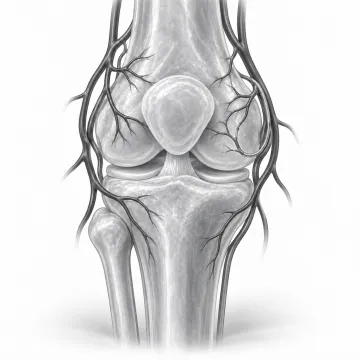
Genicular artery embolization
Calm knee arthritis pain by treating inflamed vessels, through a pinhole and without surgery.
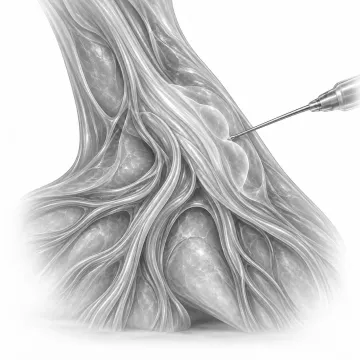
Nerve blocks
Pinpoint and calm the nerve carrying your pain with a precise, image-guided injection.
Peripheral nerve stimulators
Ease pain in the back, shoulder, knee or a limb with a thin wire and gentle electrical pulses.
Shoulder embolization
An emerging pinhole treatment for frozen shoulder and tendon pain that has not settled.
Written for patients by the Palo Alto Interventional team. General information only; your own plan depends on your health and imaging.
Talk to us about your options
Request a consultation online, or call 650-404-8445, Monday to Friday, 8 am to 5 pm. You can also ask your doctor to send a referral. We will review your imaging and help you decide whether a procedure makes sense.