
Jejunostomy tube (J tube)
Feed directly into the intestine when the stomach can't.
A jejunostomy tube, or J tube, goes through the belly wall straight into the small intestine. It is used when the stomach has been removed, cannot be reached or cannot be used. Placement usually takes about 45 to 60 minutes.
- Same day or overnight
- 45–60 minutes
- Moderate sedation
- Pump feeding
 Fabio Komlos, MDInterventional radiologist
 Watch the video explanation21:46 video · Feeding Tube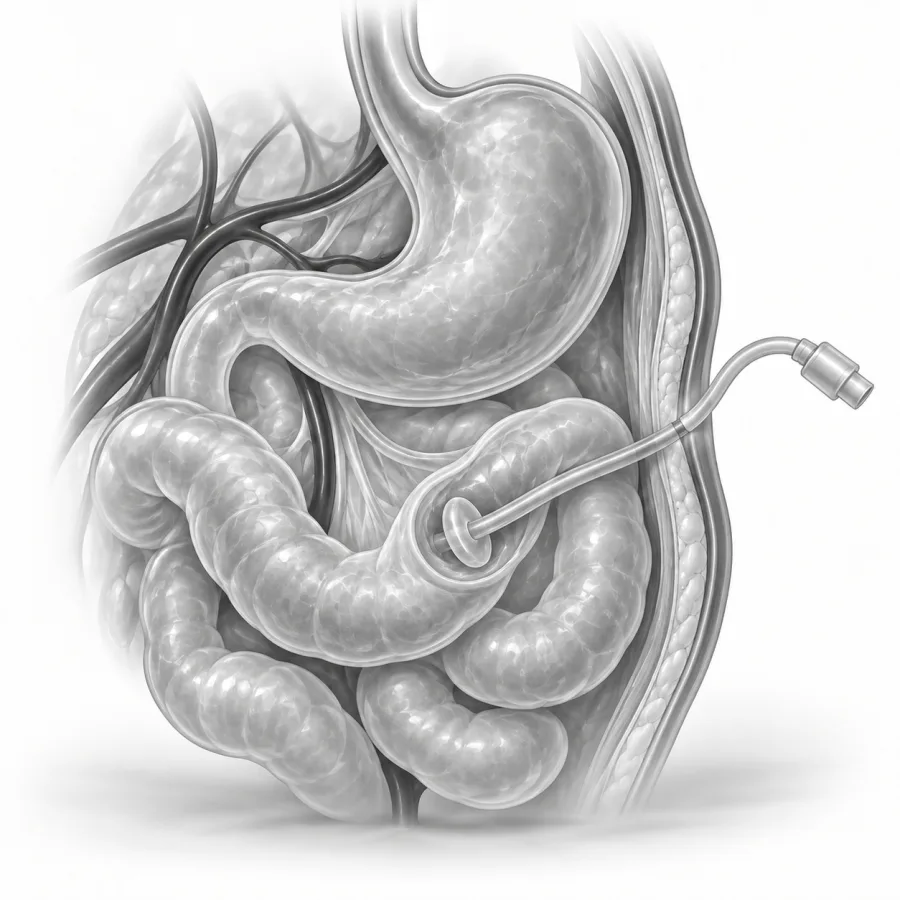
Nutrition goes straight to where it is absorbed.
Feeding Tube
Dr. Fabio Komlos walks through jejunostomy tube (j tube) the way he explains it in clinic, using the same images he uses to plan treatment.
Fabio Komlos, MDInterventional radiologist · 21:46How do you take care of your feeding tube
8:06
What is a J tube?
The jejunum is the middle part of the small intestine, where most nutrients are absorbed. A jejunostomy tube is a thin, soft tube that passes through the belly wall directly into a loop of the jejunum. Unlike a GJ tube, it does not pass through the stomach.
A direct J tube is less common than a G or GJ tube. We usually recommend it when the stomach is not available. Surgeons can also place J tubes during an operation. Interventional radiologists place them through the skin using X-ray, and sometimes ultrasound or CT, to find a loop of bowel close to the belly wall.
On X-ray, contrast dye through the new tube outlines the small intestine as a white, feathery pattern, which is different from the smooth folds of the stomach.
Who needs one, and who may not
A direct J tube may be right if
- Most or all of your stomach has been removed (gastrectomy)
- Your stomach was pulled up into the chest during esophagus surgery
- A tumor or scarring blocks access to the stomach
- A GJ tube keeps flipping back into the stomach
How it compares with the alternatives
| Image-guided J tube | Surgical J tube | GJ tube | |
|---|---|---|---|
| How it is placed | Through the skin with X-ray | During an operation | Through the skin into the stomach, then the intestine |
| Anesthesia | Moderate sedation | General anesthesia | Moderate sedation |
| Needs a stomach | No | No | Yes |
| Technical difficulty | Higher; the bowel moves | Moderate | Lower |
| Replacing it | Usually in the X-ray room | Usually in the X-ray room | In the X-ray room |
Because a loop of small intestine is thin and moves, a direct J tube is harder to place than a G tube. Not everyone has a loop of bowel in a safe position. If a safe path is not found, surgery is the alternative.
How to prepare
- We review your CT scan beforehand to find a safe loop of intestine.
- Tell us about blood thinners. Some need to be paused. See blood thinners.
- Do not eat for 6 hours before. Clear liquids may be allowed until 2 hours before, unless we tell you otherwise.
- Ask your pharmacist which of your medicines can be given as liquids through a thin tube.
- Plan for an adult to drive you home, or an overnight stay if your team recommends it. Read before your procedure.
What happens, step by step
The procedure is done at El Camino Hospital by your interventional radiologist with a nurse and technologist. Your heart rate, blood pressure and oxygen are watched throughout.
- 1Relaxing and planning
Moderate sedation helps you relax. We use X-ray, and sometimes ultrasound or CT, to find a loop of jejunum near the belly wall. Sometimes a thin tube through the nose or an existing tube is used to fill the bowel with a little air or dye.
- 2Anchoring the bowel
After numbing the skin, we place small anchors called T-fasteners to hold the loop of intestine against the belly wall.
- 3Placing the tube
A needle and guidewire enter the intestine. The opening is widened a little and the J tube is passed over the wire, pointing downstream.
- 4Checking and finishing
Contrast dye confirms the tip is in the intestine. The tube is secured to the skin and covered with a dressing.
Recovery and care at home
- First hoursYou recover while nurses check your site and vital signs. Feeding is started slowly as your team directs.
- Next dayYou may shower. Pat the site dry afterward. Soreness is expected for 2 to 3 days.
- First weekAvoid heavy lifting and strenuous activity. Watch the site for redness or leaking.
- 1 to 4 weeksThe T-fasteners loosen and fall off, or we remove them in clinic.
- Feed slowly by pump. The intestine cannot hold a large volume at once. Fast feeding causes cramps, bloating and diarrhea.
- Flush often. Use water before and after each feeding or medicine and every 4 hours during continuous feeds. Your team will tell you the amount.
- Use liquid medicines whenever possible, and never force a flush.
- Keep the tube secured with tape or a stabilizing device. A J tube is thin and can be pulled out more easily than a balloon G tube.
- Clean the skin daily with soap and water and keep it dry. No baths or swimming until the site has healed.
Most of my patients who need a direct J tube have been through a lot already, often a major stomach or esophagus operation. Before the procedure, I study the CT slice by slice to find a loop of bowel that sits right under the belly wall, with nothing in between. If I cannot find a safe window, I will tell you honestly and we will talk about the surgical option instead.Fabio Komlos, MD, interventional radiologist · About Dr. Fabio Komlos
Tubes for Duopa therapy
Duopa is a gel form of carbidopa and levodopa for advanced Parkinson disease. Pills have to pass through the stomach first, and in Parkinson disease the stomach often empties slowly and unpredictably. That can make the medicine kick in late or wear off early. Pumping the gel directly into the jejunum gives steadier absorption.
Duopa is usually delivered through a special tube that enters the stomach and extends into the jejunum, a type of GJ tube often called a PEG-J or intestinal port. Placement and care are the same as described on our GJ tube page. Your neurologist manages the medicine and pump. We take care of the tube, including clogs, leaks and changes.
If you need to stop the Duopa pump for more than a short time, follow your neurologist's instructions about taking your carbidopa-levodopa pills. A clogged tube does not usually need the emergency room; call us during office hours and we can usually fix it within a day.
Risks and what to watch for
- Clogging of the thin tube, which may need replacement.
- Dislodgement, which is more likely than with a balloon G tube.
- Leaking of intestinal fluid around the tube, which can irritate the skin.
- Infection at the skin or, rarely, inside the belly (peritonitis).
- Bleeding or injury to the bowel, which are uncommon.
- Rarely, the intestine can twist around the tube (volvulus), causing a blockage.
Common questions
Why not a regular G tube?
Can I feed with a syringe?
What if my J tube comes out?
Does the procedure hurt?
Who manages my Duopa?
Will insurance cover it?
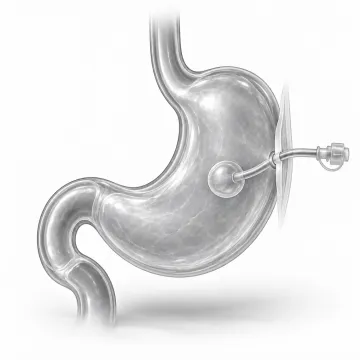
Feeding tubes
G, GJ and J tubes explained: why you might need one and how we place them.
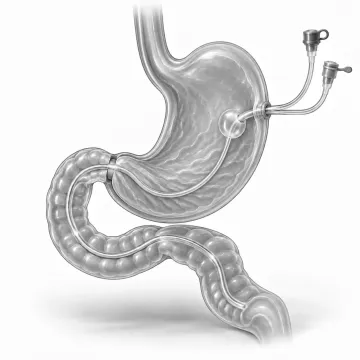
Gastrojejunostomy tube (GJ tube)
A feeding tube that delivers nutrition past the stomach, into the small intestine.
Gastrostomy tube (G tube)
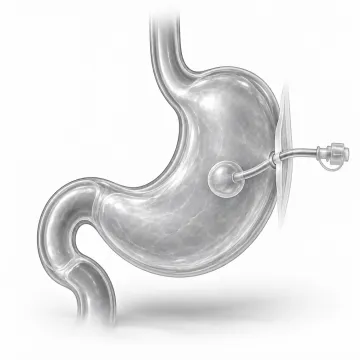
A feeding tube into the stomach, placed with X-ray guidance through a small opening.
Palliative cancer care
Small procedures that ease fluid build-up, pain, blockages and eating problems caused by cancer.
Written for patients by the Palo Alto Interventional team. General information only; your own plan depends on your health and imaging.
Talk to us about your options
Request a consultation online, or call 650-404-8445, Monday to Friday, 8 am to 5 pm. You can also ask your doctor to send a referral. We will review your imaging and help you decide whether a procedure makes sense.