
Gastrostomy tube (G tube)
Get nutrition straight to your stomach, safely.
A gastrostomy tube, or G tube, is a soft tube placed through the belly wall into the stomach for feeding, water and medicine. We place it with X-ray guidance in about 30 minutes, without an endoscope.
- Same day or overnight
- About 30 minutes
- Moderate sedation
- Feed after 24 hours
 Fabio Komlos, MDInterventional radiologist
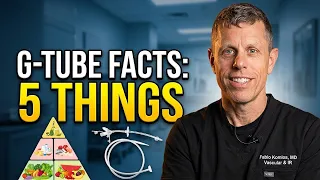 Watch the video explanation6:26 video · Your First G-Tube: What Happens When You Don't Flush It Properly?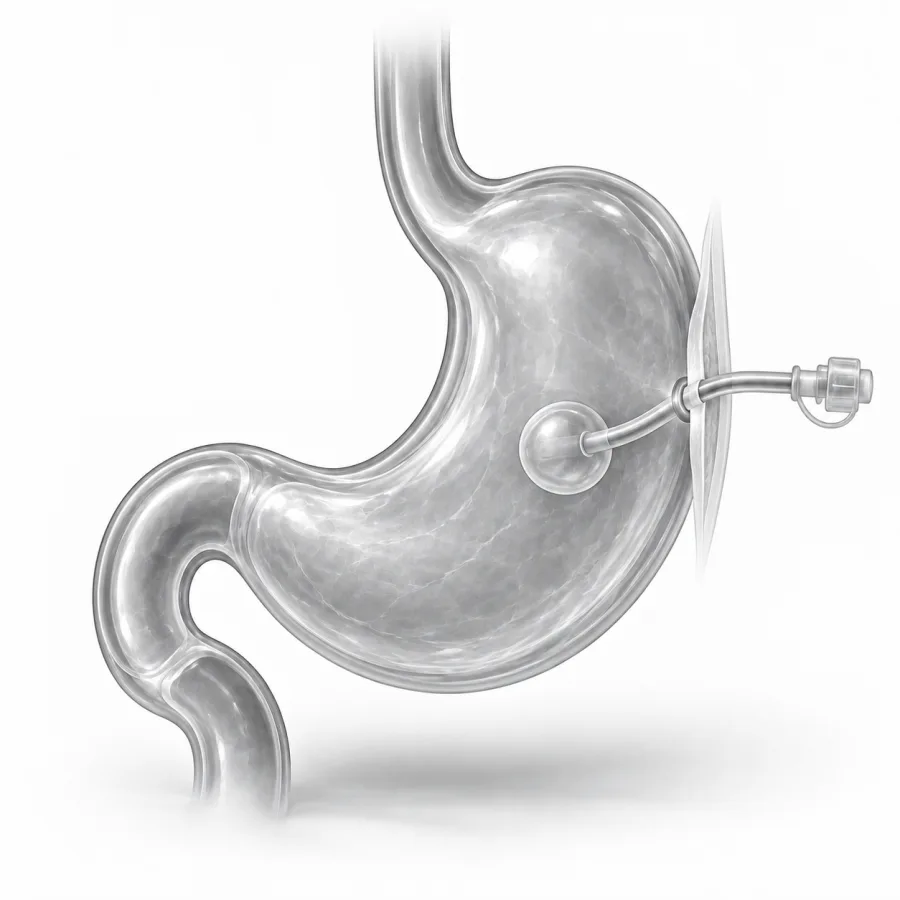
Placed through the belly wall with X-ray guidance.
Your First G-Tube: What Happens When You Don't Flush It Properly?
Dr. Fabio Komlos walks through gastrostomy tube (g tube) the way he explains it in clinic, using the same images he uses to plan treatment.
Fabio Komlos, MDInterventional radiologist · 6:26Feeding Tube
21:46
How do you take care of your feeding tube
8:06
What is a G tube?
A gastrostomy tube is a soft plastic tube that passes through a small opening in the upper left belly straight into the stomach. You may also hear it called a G tube, or a PEG when it is placed with an endoscope. We place ours with X-ray guidance, sometimes called a radiologic gastrostomy.
Inside the stomach, a small balloon filled with water keeps the tube from slipping out. Outside, a flat disc called a bolster or flange rests on the skin and keeps the tube snug. The outer end has ports for feeding and medicines.
On the X-ray screen, the stomach looks like a dark air-filled bubble. A little contrast dye through the new tube outlines the stomach folds in white, which confirms that the tip is in the right place.
Who needs one, and who may not
A G tube often helps if
- You cannot swallow safely after a stroke or from a nerve or muscle disease
- A tumor or radiation treatment makes swallowing painful or impossible
- You cannot eat enough calories to keep your weight up
- You need a venting tube to let gas and fluid out because of a blockage lower down
- Your stomach empties normally
A different option may be better if
- Your stomach empties very slowly or you often vomit feeds; a GJ tube may work better
- You have had most of your stomach removed; a J tube may be needed
- You have a large amount of fluid in the belly (ascites) that is not controlled
- You have a bleeding problem that cannot be corrected
- You need tube feeding for only a few weeks; a thin tube through the nose may be enough
How it compares with the alternatives
| X-ray-guided G tube | Endoscopic PEG | Surgical G tube | |
|---|---|---|---|
| Who places it | Interventional radiologist | Gastroenterologist | Surgeon |
| Scope through the mouth | No, only a thin nose tube | Yes | No |
| Sedation | Moderate sedation | Moderate or deep sedation | Usually general anesthesia |
| Good when | Throat or esophagus is narrowed | Mouth and esophagus are open | Already having belly surgery |
| Typical recovery | Home the same day or next day | Home the same day or next day | Often a hospital stay |
All three methods work well. The best choice depends on your anatomy, other procedures you may need and local expertise. A thin tube through the nose, called a nasogastric tube, is an option for short-term feeding but is uncomfortable to keep for more than a few weeks.
How to prepare
- Tell us about blood thinners. Some need to be paused. See blood thinners.
- Do not eat for 6 hours before. Clear liquids may be allowed until 2 hours before, unless we tell you otherwise. If you already have a nose tube, feeds are stopped beforehand.
- Sometimes we give a small drink of contrast dye the night before so the colon shows up on X-ray and can be avoided.
- Plan for an adult to drive you home, or plan to stay overnight if your team recommends it.
- Read before your procedure and sedation.
What happens, step by step
The procedure is done at El Camino Hospital. Two nurses, a technologist and your interventional radiologist care for you, and your heart rate, blood pressure and oxygen are watched throughout.
- 1Relaxing and preparing
Moderate sedation through your IV helps you relax. A thin tube is passed through your nose into your stomach.
- 2Filling the stomach with air
Air is gently pumped into your stomach through the nose tube. This pushes the stomach up against the belly wall and makes it easy to see on X-ray.
- 3Anchoring the stomach
After numbing the skin, we place 2 to 4 small anchors called T-fasteners. They hold the stomach wall against the belly wall while it heals.
- 4Placing the tube
Between the anchors, a needle enters the stomach and a guidewire is passed. The opening is gently widened and the G tube slides in over the wire. The balloon is filled with water.
- 5Checking and finishing
Contrast dye confirms the position. The outer disc is snugged to the skin, and the nose tube is removed. The whole procedure takes about 30 minutes.
Recovery and care at home
- First hourYou recover while the nurses check your site and vital signs. Family can join you.
- Rest of the dayClear liquids by mouth only, if you are allowed to eat. The tube is not used yet. No driving if you had sedation.
- Next dayIf your belly is not very painful, start using the tube as instructed and slowly return to your usual diet. You may shower.
- First weekSoreness fades over 2 to 3 days. No heavy lifting or strenuous activity for about 1 week.
- 1 to 4 weeksThe T-fasteners fall off on their own. Throw them away. If they are still there after 2 to 3 weeks, we can remove them in clinic.
Flushing: the habit that saves your tube
- Flush with about 30 mL of tap or drinking water before and after every feeding and every medicine, and at least once a day if you are not using the tube.
- If you feed with a pump all day, flush every 4 hours.
- Give medicines one at a time, as liquids when possible. Crush tablets finely and mix with water, and flush between each one. Ask your pharmacist before crushing any pill.
- Push with firm, steady pressure. If it will not go, do not force it. Try warm water and gentle back-and-forth pushes on the syringe, then call us.
- Never push a wire or other object into the tube.
If a tube is not flushed well, formula and medicine build up inside it and harden. A clogged tube cannot be used for food or medicine, and it often has to be replaced.
Caring for the skin
- Clean around the tube daily with soap and water, then dry it well. Change the dressing daily for the first few days.
- Once the site is dry, you can usually leave it uncovered. Avoid ointments; they make the skin soggy and the tube slippery.
- Check that the outer disc is snug but not tight. You should be able to turn the tube gently. If it is loose, gently pull the tube up and slide the disc down to the skin.
- A small amount of clear or tan drainage and a little pink tissue around the tube are common.
The biggest problem I see with new G tubes is not a complication of the procedure. It is a tube that clogs in the first few weeks because it was not flushed. I ask every patient and caregiver to flush before and after everything that goes in, and to call early if the tube feels tight, before it blocks completely.Fabio Komlos, MD, interventional radiologist · About Dr. Fabio Komlos
Risks and what to watch for
Image-guided G tube placement is safe for most people. Serious complications are uncommon. The most common problems are minor: soreness, some leakage and skin irritation.
- Infection at the skin, with redness, warmth and pus. It is usually treated with antibiotics by mouth.
- Leaking of stomach fluid around the tube, often from a loose disc or a heavy tube pulling to one side.
- Bleeding from the stomach wall, which is rare.
- Peritonitis, infection inside the belly from a leak, which is rare but serious. It causes pain all over the belly and fever.
- Dislodgement, when the tube comes out. The opening can start to close within hours.
- Clogging, which is preventable with good flushing.
Common questions
What happens if I don't flush my tube?
What if my tube falls out?
Can I shower and swim?
What are the little buttons next to the tube?
How long does a G tube last?
Can I switch to a low-profile button?
Will insurance cover it?
Feeding tubes
G, GJ and J tubes explained: why you might need one and how we place them.
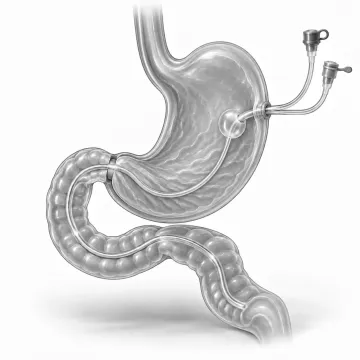
Gastrojejunostomy tube (GJ tube)
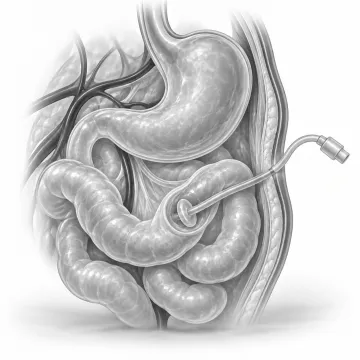
A feeding tube that delivers nutrition past the stomach, into the small intestine.
Jejunostomy tube (J tube)
A feeding tube placed directly into the small intestine, and tubes for Duopa therapy.
Palliative cancer care
Small procedures that ease fluid build-up, pain, blockages and eating problems caused by cancer.
Written for patients by the Palo Alto Interventional team. General information only; your own plan depends on your health and imaging.
Talk to us about your options
Request a consultation online, or call 650-404-8445, Monday to Friday, 8 am to 5 pm. You can also ask your doctor to send a referral. We will review your imaging and help you decide whether a procedure makes sense.