
Prostate artery embolization
Treat an enlarged prostate without surgery.
Prostate artery embolization (PAE) shrinks an enlarged prostate by slowing its blood supply, through a pinhole in the wrist or upper thigh. Most men go home the same day and are back to light activity within a few days.
- Outpatient
- 1–2 hours
- Moderate sedation
- Home the same day
 Fabio Komlos, MDInterventional radiologist
 Watch the video explanation7:08 video · Prostate Artery Embolization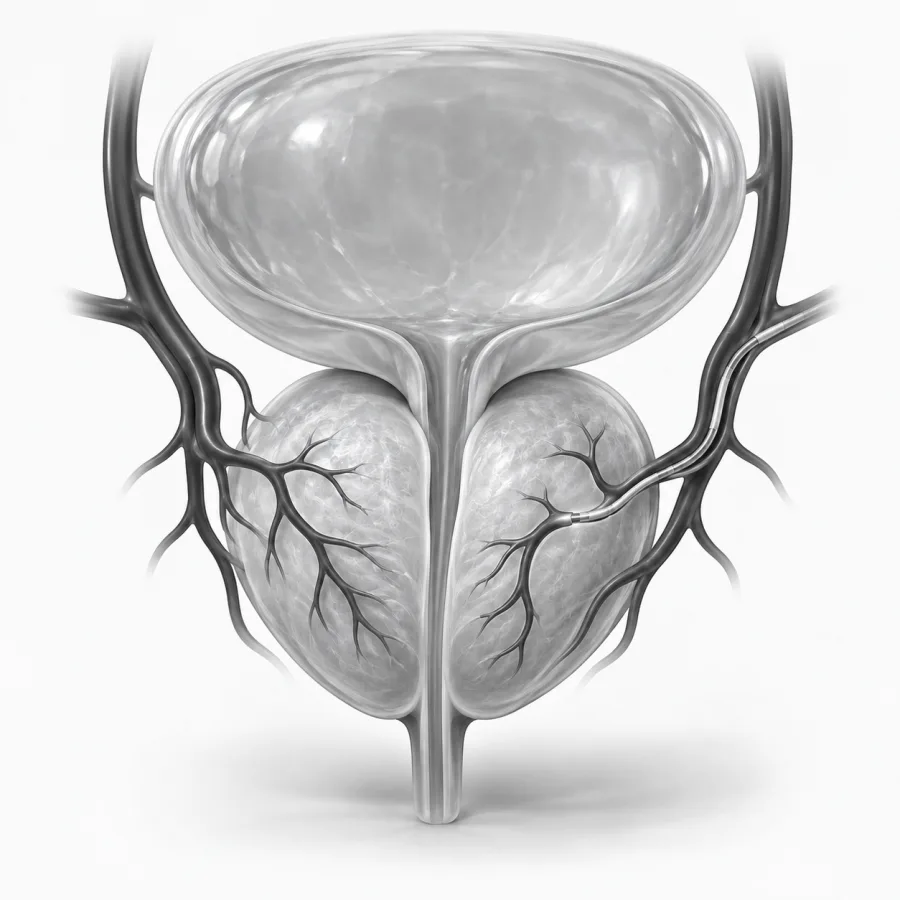
 On imaging
Angiogram of the prostate arteries: contrast makes the small vessels feeding the prostate show up as dark branches.
Prostate Artery Embolization
Dr. Fabio Komlos walks through prostate artery embolization the way he explains it in clinic, using the same images he uses to plan treatment.
Fabio Komlos, MDInterventional radiologist · 7:08Minimally Invasive Prostate Relief: What Every Man Should Know
3:20
Enlarged Prostate? This Treatment Might Be Your Answer
3:20
Who are good candidates for PAE?
1:18
Quick answers
Under a minute eachWhat is an enlarged prostate?
The prostate is a small gland that sits just below the bladder and wraps around the urethra, the tube that carries urine out of the body. In most men the prostate slowly grows after age 40. When it grows large enough to squeeze the urethra, it is called an enlarged prostate, or benign prostatic hyperplasia (BPH). Benign means it is not cancer, and BPH does not turn into cancer.
BPH is very common. About half of men in their 60s and most men in their 80s have some symptoms. The size of the prostate does not always match how bad the symptoms are, so treatment is based on how much the symptoms bother you.
Common symptoms
- A weak or slow urine stream
- Trouble starting to urinate, or needing to push or strain
- Stopping and starting while you urinate
- Feeling that your bladder is not empty after you go
- Needing to go often, sometimes every hour or two
- Getting up at night to urinate, called nocturia
- A sudden, strong urge that is hard to hold
Prostate artery embolization (PAE) treats BPH from inside the blood vessels. An interventional radiologist, a doctor who uses X-ray and ultrasound to guide small tubes through the body, places a thin catheter into the small arteries that feed the prostate. Tiny beads are then released to reduce the blood flow. Over the following weeks the prostate softens and shrinks, which takes pressure off the urethra.
How we measure your symptoms: the IPSS
Only you can say how much your symptoms affect your life. To track them in a fair and repeatable way, we use a short questionnaire called the International Prostate Symptom Score (IPSS). You fill it out before treatment and again at follow-up visits, usually around 1, 3 and 6 months, so we can see how much you have improved.
The seven symptom questions (about the past month)
- 1How often have you felt your bladder was not fully empty?
- 2How often did you need to go again less than 2 hours after you last went?
- 3How often did you stop and start again while urinating?
- 4How often was it hard to put off urinating?
- 5How often was your stream weak?
- 6How often did you have to push or strain to begin?
- 7How many times did you usually get up at night to urinate?
Each of the seven questions is scored from 0 (not at all) to 5 (almost always, or 5 or more times a night). The total runs from 0 to 35. 0 to 7 is mild, 8 to 19 is moderate, and 20 to 35 is severe. An eighth question asks how you would feel if you had to live with your urinary symptoms as they are now. It is scored separately, from 0 (delighted) to 6 (terrible), and tells us about your quality of life.
Most men who come to us for PAE have moderate or severe scores. After a successful treatment, it is common for the score to drop by many points, and for the quality-of-life answer to move from unhappy toward pleased.
You can find the full IPSS questionnaire online or ask us for a copy. Bring your completed form to your first visit.
Who PAE helps, and who it may not
PAE is a good option for many men whose urinary symptoms still bother them despite medicine, or who cannot tolerate the side effects of medicine. It is also a choice for men who want to avoid surgery, who want to protect their sexual function, or who have health problems that make surgery and general anesthesia riskier.
Often a good candidate
- Moderate or severe symptoms (IPSS of 8 or more)
- Symptoms not controlled by medicine, or side effects from medicine
- A larger prostate, usually over about 40 to 50 grams
- Wish to avoid surgery or protect ejaculation
- Higher surgical risk, or taking blood thinners that are hard to stop
- Men who depend on a urinary catheter because of BPH
May not be right if you have
- Untreated prostate cancer, or a PSA test that has not been explained
- A weak bladder muscle or nerve problem affecting the bladder
- A narrowing of the urethra from scar tissue (stricture)
- Large bladder stones or a large pouch in the bladder wall
- An active urinary or prostate infection
- Very hardened or twisted pelvic arteries, or severe kidney disease
Before we decide, we usually review a PSA blood test, a urine test, and imaging of the prostate, most often an MRI. Some men also have a CT scan of the pelvic arteries to plan the route, and a test of urine flow and how much urine stays in the bladder after you go. Many of our patients also see a urologist, a surgeon who specializes in the urinary tract, so that every option is on the table.
When I meet a man with BPH, I look at three things together: how much his symptoms bother him, how his bladder is working, and what his prostate and its arteries look like on the MRI or CT. A large prostate with a big middle lobe and healthy arteries is usually an excellent setup for PAE. If something else is driving the symptoms, like a tired bladder or a stricture, I tell him honestly that PAE is not the right tool and help him find the one that is.Fabio Komlos, MD, interventional radiologist · About Dr. Fabio Komlos
How PAE compares with other treatments
There is no single best treatment for everyone. Medicines are usually the first step. Alpha blockers such as tamsulosin relax the muscle around the urethra, and 5-alpha reductase inhibitors such as finasteride slowly shrink the prostate. They help many men, but can cause dizziness, tiredness, a stuffy nose, and changes in ejaculation or sex drive.
When medicine is not enough, the choices include PAE and several surgical procedures done by a urologist through the urethra. These include transurethral resection of the prostate (TURP), laser enucleation (HoLEP), water vapor therapy (Rezum) and implants that hold the prostate open (UroLift). Surgery through the urethra often gives the fastest and largest improvement in urine flow. PAE avoids instruments in the urethra and has a lower chance of sexual side effects, but its effect builds more slowly.
| PAE | TURP or laser surgery | Rezum or UroLift | |
|---|---|---|---|
| How it is done | Catheter through a wrist or thigh artery | Scope through the urethra, tissue removed | Scope through the urethra, steam or implants |
| Anesthesia | Moderate sedation | General or spinal | Local, sedation or general |
| Urinary catheter after | Rarely needed | Usually 1–3 days | Sometimes, for days |
| Ejaculation changes | Uncommon | Common (most men) | Uncommon |
| Improvement | Gradual, over 1–3 months | Fast and usually large | Over weeks |
| Works for very large prostates | Yes | Yes (laser) | Limited |
PAE does not rule out surgery later. If symptoms return or the result is not enough, a urologist can still perform any of the surgical options.
How to prepare
- Tell us about all your medicines, especially blood thinners. We will tell you if and when to pause them. See blood thinners and procedures.
- Keep taking your prostate medicines unless we tell you otherwise. Stopping them suddenly can make it harder to urinate.
- Tell us if you have had a reaction to X-ray contrast dye, have kidney disease or diabetes.
- Do not eat for about 8 hours before the procedure. You can take your morning medicines with small sips of water.
- Plan for an adult to drive you home, because you will receive sedation.
- Leave jewelry and valuables at home and wear loose, comfortable clothes.
You can read more in before your procedure and what to expect from sedation.
What happens on the day
PAE is done at El Camino Hospital in an interventional radiology suite, a procedure room with a large X-ray camera. A team of nurses and a radiology technologist care for you alongside your interventional radiologist.
- 1Getting ready
A nurse places an IV in your arm and checks your vital signs. In the procedure room you lie on your back and are connected to heart, blood pressure and oxygen monitors. You receive moderate sedation, sometimes called twilight sleep, so you are relaxed and drowsy but breathing on your own.
- 2A pinhole in the wrist or thigh
The skin over the artery in your wrist or upper thigh is cleaned and numbed. Using ultrasound, the doctor places a thin tube into the artery through a puncture about 2 mm wide. You may feel pressure, but it should not be painful.
- 3Mapping the prostate arteries
Under X-ray guidance, a catheter about the width of a strand of spaghetti is guided into the pelvis. A small amount of contrast dye shows the arteries on the screen. A cone-beam CT, a quick 3D scan taken on the table, confirms which branches feed the prostate and which feed nearby organs.
- 4Embolization
An even thinner microcatheter is advanced into each prostate artery and tiny beads, each smaller than a grain of sand, are slowly released until the flow slows. The same steps are repeated on the other side. You may feel warmth or a brief urge to urinate.
- 5Closing and resting
The catheter is removed. A wrist band or a small plug or pressure closes the puncture, with no stitches. You rest in recovery for about 2 hours, eat and drink, see your family, and most men go home the same day.
What we seeRecovery and aftercare
Most men feel tired for a day and then return to light activity. As the prostate reacts to the treatment it becomes inflamed for a while, which can temporarily make urinary symptoms worse before they get better. This is expected and usually settles within 1 to 2 weeks.
- Day of the procedureRest at home. No driving, alcohol or important decisions for the rest of the day because of the sedation. Eat light meals and drink plenty of fluids.
- First 24 hoursNo exercise, heavy lifting or strenuous activity. If the wrist was used, avoid pushing or lifting with that hand. You may shower the next day, but do not soak the puncture in a bath, hot tub or pool for 1 week.
- Days 2 to 7Return to normal daily activities and driving. Urinating more often, getting up at night, urgency, mild burning, pelvic ache, and a little blood in urine or semen are common and improve day by day.
- Weeks 2 to 12Irritation fades and the flow gradually gets stronger as the prostate shrinks. Most men notice the main change within 1 to 3 months.
- 1, 3 and 6 monthsFollow-up visits and a repeat IPSS. We may talk about slowly reducing your prostate medicines, never all at once.
Medicines after PAE
- We usually prescribe an antibiotic for 7 days to help prevent a urinary infection.
- Acetaminophen (Tylenol) or ibuprofen (Advil, Motrin) helps with mild discomfort, if these are safe for you. Some men also receive a short course of an anti-inflammatory medicine.
- Continue your usual medicines, including prostate medicines, unless we tell you otherwise.
Results and risks
In published studies, about 3 in 4 men notice a clear improvement in their urinary symptoms and quality of life after PAE, with results best when both sides of the prostate are treated. On average the IPSS drops by roughly 10 or more points. The benefit lasts for years in most men, but symptoms come back in some, about 1 in 5 over several years, and a repeat PAE or surgery can then be considered.
Serious problems are uncommon. Most side effects are short-lived and part of what is called post-PAE syndrome: urinary burning and frequency, pelvic discomfort, mild fever, nausea and tiredness for a few days.
Possible risks
- Bruising or a small collection of blood (hematoma) at the puncture site
- Blood in the urine, semen or stool for a short time
- Bladder spasms or burning with urination
- Temporary trouble urinating that needs a urinary catheter for a few days to weeks, in a small number of men
- Urinary or prostate infection, which is uncommon
- Rarely, beads reaching nearby organs such as the bladder, rectum or penis. Careful mapping with cone-beam CT lowers this risk.
- Reaction to contrast dye or effects on the kidneys, especially if kidney function is already reduced
Unlike most prostate surgeries, PAE rarely causes erection problems, leaking urine, or dry orgasm (retrograde ejaculation). Some men notice a smaller amount of semen.
Common questions
Does PAE hurt?
Will PAE affect my sex life?
Will I need a urinary catheter?
How soon will I notice a difference?
When can I drive and go back to work?
Can I stop my prostate medicines afterward?
Is PAE covered by insurance?
Does PAE treat or prevent prostate cancer?
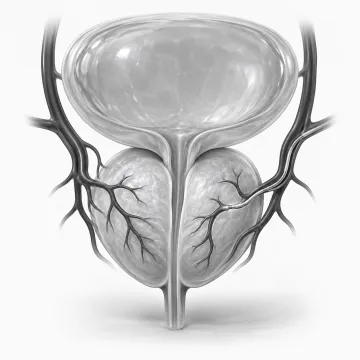
Embolization
Block selected blood vessels from the inside to stop bleeding, shrink growths or ease pain.
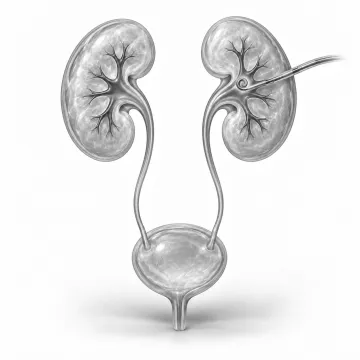
Interventional urology
Drains and stents that relieve a blocked kidney, placed with X-ray guidance through the skin.
Uterine fibroid embolization
Shrink fibroids through a pinhole, without removing the uterus or a large incision.
Varicocele embolization
Fix a varicocele through a pinhole, with no incision on the scrotum and a quick return to work.
Written for patients by the Palo Alto Interventional team. General information only; your own plan depends on your health and imaging.
Talk to us about your options
Request a consultation online, or call 650-404-8445, Monday to Friday, 8 am to 5 pm. You can also ask your doctor to send a referral. We will review your imaging and help you decide whether a procedure makes sense.