
Ureteral stent
Drain a blocked kidney with nothing outside your body.
A ureteral stent is a soft tube, about 25 cm long, that sits fully inside you from the kidney to the bladder and holds a blocked ureter open. We place it with X-ray guidance, usually in 30 to 60 minutes.
- 30–60 minutes
- Moderate sedation
- No outside bag
- Changed every 3–6 mo
 Fabio Komlos, MDInterventional radiologist
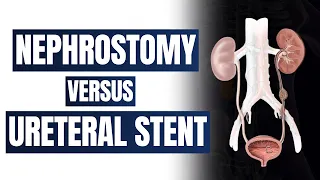 Watch the video explanation23:30 video · What are Double J stents, Nephrostomy tubes, and NU stents?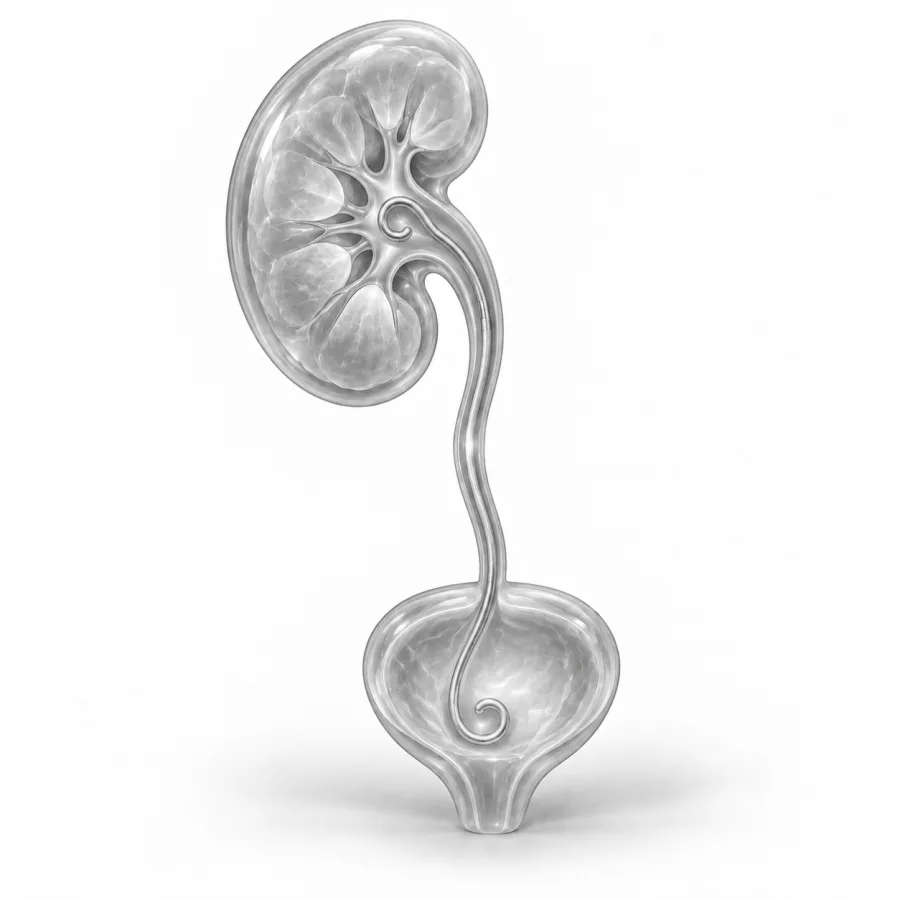
Once the stent is in, nothing shows on the outside.
What are Double J stents, Nephrostomy tubes, and NU stents?
Dr. Fabio Komlos walks through ureteral stent the way he explains it in clinic, using the same images he uses to plan treatment.
Fabio Komlos, MDInterventional radiologist · 23:30Before your procedure
3:29
What is a ureteral stent?
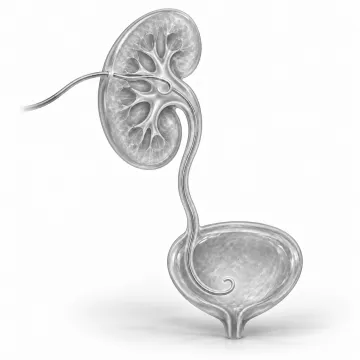
Urine travels from each kidney to the bladder through a narrow tube called the ureter. A stone, tumor, scar or swollen lymph nodes can squeeze or block it. A ureteral stent is a thin, soft plastic tube that runs inside the ureter and keeps it open so urine can reach the bladder.
Each end of the stent curls into a small loop, like the letter J. One loop sits in the kidney and the other in the bladder, which keeps the stent from moving. That is why it is often called a double-J stent. Unlike a nephrostomy tube, nothing comes out of your skin.
On the X-ray, the stent is a thin white line running down the side of the spine, with one curl in the kidney and another curl low in the pelvis inside the bladder.
Who it helps
Urologists (surgeons of the urinary tract) place most ureteral stents from below, through the bladder, using a small camera. We place them from above, through the kidney, when the route from below does not work or is not safe. Often you already have a nephrostomy tube, and we use its track, so no new needle stick is needed.
Good candidates
- A blockage that will last weeks to months
- A nephrostomy tube you would like to replace
- A stent could not be placed from below
- A path through the blockage can be crossed with a wire
May not be right if
- The kidney is actively infected (drain it first)
- The bladder is very small, scarred or bleeding
- The blockage is too tight to cross
- Stent symptoms were intolerable before
How it compares with other options
| Ureteral stent | Nephrostomy tube | Nephroureteral stent | |
|---|---|---|---|
| Outside tube or bag | None | Yes, bag | Yes, can be capped |
| Bladder symptoms | Common | Rare | Sometimes |
| Tube care at home | None | Daily dressing and bag | Daily dressing |
| Usual change interval | 3–6 months | 2–3 months | 2–3 months |
| How it is changed | Through bladder or kidney | Over a wire at the back | Over a wire at the back |
If you are not sure a fully internal stent will work, we may first place a nephroureteral stent. It gives the same internal drainage, but keeps an outside tube as a safety valve until we know urine flows well. The interventional urology page explains how these options fit together.
How to prepare
- Tell us about blood thinners. We will tell you whether to pause them and for how long. See blood thinners.
- Do not eat for about 6 hours before. Clear liquids are usually fine until 2 hours before. We will confirm your times.
- Tell us about any allergy to contrast dye, and whether you might be pregnant.
- Bring a list of your medicines and arrange for an adult to drive you home.
- If you have a fever or feel unwell in the days before, call us. An infection needs to be treated first.
What happens during the procedure
- 1Getting comfortable
You lie on your stomach on the X-ray table. You receive moderate sedation through your IV, and monitors track your heart, blood pressure and oxygen.
- 2Mapping the ureter
We numb the skin and go in through your existing nephrostomy track, or through a new small needle stick into the kidney. Contrast dye shows the ureter and the blockage on X-ray.
- 3Crossing the blockage
A thin guidewire is gently steered down the ureter, through the narrow spot and into the bladder. The stent then slides over the wire until one curl sits in the bladder and the other in the kidney.
- 4Checking and finishing
We confirm the position on X-ray. Sometimes we leave a small capped tube in your back for a few days as a safety valve, and remove it once we know the stent drains well.
You rest for about an hour afterward. Most people go home the same day. You can eat and drink once you are fully awake.
What having a stent feels like
Many people barely notice their stent. Others have bothersome symptoms, especially in the first few weeks. These are caused by the curl of the stent rubbing the bladder wall and by urine flowing back up the stent when you pee. They are not dangerous, and they usually settle as your body gets used to it.
Common stent symptoms
- Needing to pee often or urgently
- A burning feeling or a sense that the bladder is not empty
- An ache in your side or back while peeing, which fades when you finish
- Pink urine on and off, especially after exercise
- Discomfort in the lower belly or groin
Drinking plenty of water helps. Medicines can also help: tamsulosin (Flomax) relaxes the ureter, and bladder medicines such as oxybutynin or mirabegron calm spasms. Ask us or your urologist whether these are right for you.
- First dayRest. No driving, alcohol or important decisions after sedation.
- First 2–3 daysMild pelvic or back discomfort. Acetaminophen (Tylenol) usually helps.
- First weekUrine may look like rosé wine or cranberry juice. It should stay see-through.
- After 24 hoursMost normal activity, driving and work are fine. Avoid heavy lifting for a day or two.
- Every 3–6 monthsThe stent is changed or removed. Never let a stent stay in longer than planned.
Changing and removing the stent
Minerals from urine slowly coat the stent. Left too long, it can clog, break or become stuck. That is why a stent is changed on a schedule, usually every 3 to 6 months, or removed once the cause is fixed. A urologist often does this through the bladder with a small camera. We can also change it under X-ray. Keep a note of your due date and make sure a visit is booked.
I tell patients a stent is a bit like a houseguest: most are easy, some are annoying, and none should stay forever. If your symptoms are wearing you down, tell me, because medicines or a change of stent size often help. And please keep your change date on your calendar, because a forgotten stent is the one real problem I work hard to prevent.Fabio Komlos, MD, interventional radiologist · About Dr. Fabio Komlos
Risks
- Stent symptoms, as above, are the most common side effect.
- Infection of the urine or kidney. Serious infection is uncommon but needs prompt antibiotics.
- Bleeding is usually mild. Heavy bleeding is rare.
- Stent blockage or movement, which can cause the kidney to swell again and may need a new stent or a nephrostomy tube.
- Contrast reaction, which is rare and usually mild.
- Encrustation of a stent left in too long, which can make removal harder.
Common questions
Will I feel the stent?
Can I exercise with a stent?
Can I have sex with a stent?
How long can a stent stay in?
Why was a tube left in my back after the stent?
Does it hurt to have the stent placed?
Will insurance cover it?
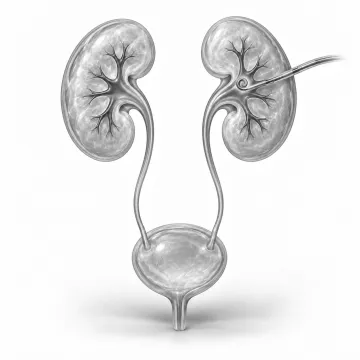
Interventional urology
Drains and stents that relieve a blocked kidney, placed with X-ray guidance through the skin.
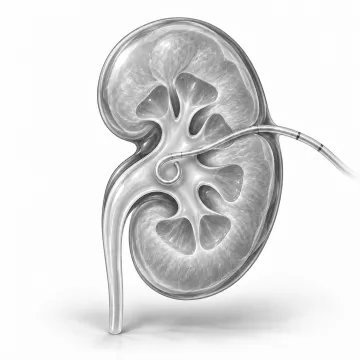
Nephrostomy tube
A thin drain from the kidney through the back that relieves a blockage or infection.
Nephroureteral stent
One tube from the back to the bladder that can drain to a bag or be capped for internal flow.
Blood thinners and your procedure
Which blood thinners may be paused before a procedure, typical hold times, and how bridging works.
Written for patients by the Palo Alto Interventional team. General information only; your own plan depends on your health and imaging.
Talk to us about your options
Request a consultation online, or call 650-404-8445, Monday to Friday, 8 am to 5 pm. You can also ask your doctor to send a referral. We will review your imaging and help you decide whether a procedure makes sense.