
Lumbar puncture and myelogram
Get a spinal tap done precisely, with X-ray guidance.
A lumbar puncture, or spinal tap, collects a small amount of the fluid around your spinal cord through a thin needle in the lower back. With X-ray guidance, it usually takes 20 to 45 minutes and you go home the same day.
- 20–45 minutes
- Local numbing
- Home the same day
- Rest 1 day after
 Fabio Komlos, MDInterventional radiologist
 Watch the video explanation3:29 video · Before your procedure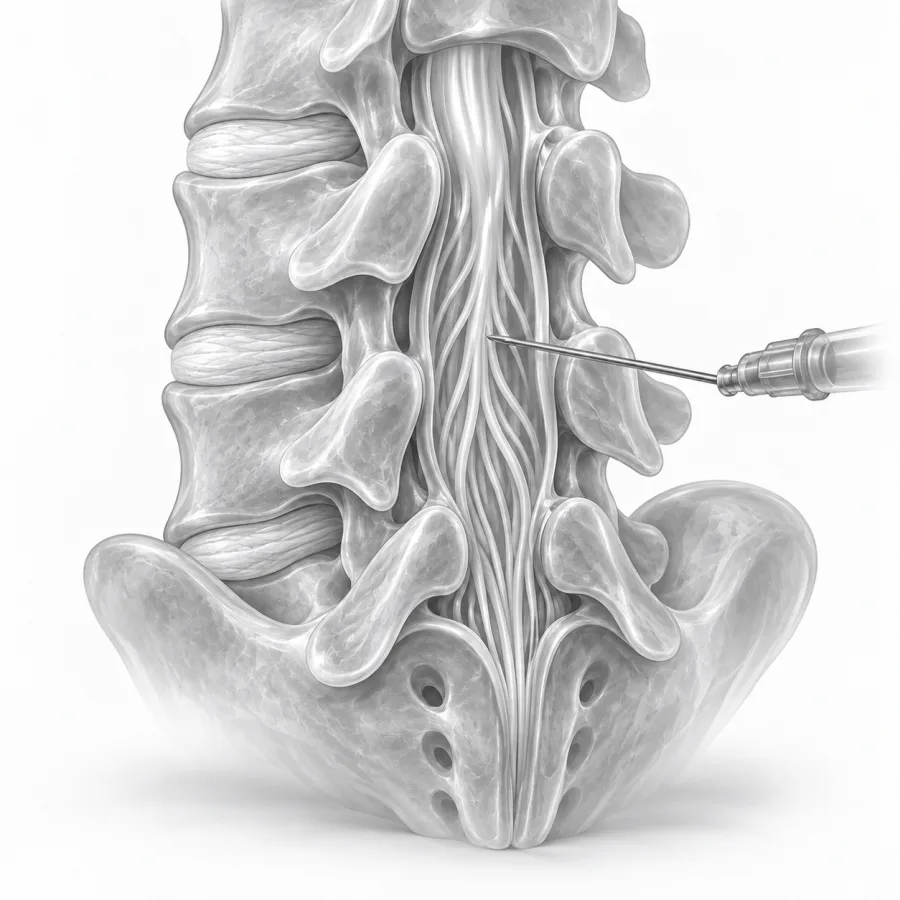
Helpful for arthritis, scoliosis, prior surgery or larger bodies.
Before your procedure
Dr. Fabio Komlos walks through lumbar puncture and myelogram the way he explains it in clinic, using the same images he uses to plan treatment.
Fabio Komlos, MDInterventional radiologist · 3:29If you are having a procedure and you are on blood thinners you need to watch this
0:43
What is a lumbar puncture?
Your brain and spinal cord float in a clear liquid called cerebrospinal fluid, or CSF. It is held inside a thin sac. In the lower back, below where the spinal cord ends, the sac contains only fluid and fine nerve roots. A thin needle placed there can safely collect fluid or deliver medicine. This is a lumbar puncture, also called a spinal tap.
Many spinal taps are done at the bedside by feel. We use live X-ray, called fluoroscopy, to guide the needle between the bones of the spine. This helps when the spine is hard to feel, such as with arthritis, scoliosis, past back surgery, a larger body size, or an earlier tap that did not work.
On the X-ray, the bones of the lower spine look like a stack of blocks. We aim the needle into the small gap between two of them, and a drop of clear fluid at the needle hub tells us we are in the right place.
Why it is done
Testing the fluid
- Infections such as meningitis
- Bleeding around the brain that a CT scan did not show
- Multiple sclerosis and other inflammatory conditions
- Some cancers that can spread to the fluid
- Proteins linked to Alzheimer's disease and other memory problems
Treatment and imaging
- Measuring and lowering pressure, for example in idiopathic intracranial hypertension, a condition of high fluid pressure
- Removing a larger amount of fluid to see if walking improves in normal pressure hydrocephalus
- Giving medicines such as chemotherapy or spinal muscular atrophy treatment into the fluid
- A myelogram: contrast dye is injected into the fluid, followed by X-rays and usually a CT scan, to show the spinal cord and nerves. It is often used when MRI is not possible, for example with some pacemakers or metal implants.
Is it right for you?
Good candidates
- A bedside tap was hard or did not work
- Arthritis, scoliosis or prior spine surgery
- A myelogram is needed
- Medicine must be given into the fluid
Extra care or another plan if
- You take blood thinners that cannot be paused
- Low platelets or a clotting problem
- Signs of high pressure in the brain from a mass
- Skin infection in the lower back
- Pregnancy (we avoid X-ray when we can)
| X-ray-guided tap | Bedside tap | |
|---|---|---|
| Where | Radiology procedure room | Hospital bed or clinic |
| Needle guidance | Live X-ray | By feel |
| Best for | Harder anatomy, myelograms | Straightforward anatomy, emergencies |
| Radiation | Small dose | None |
How to prepare
- Tell us about blood thinners. Many need to be paused for a few days. Aspirin alone often does not. See blood thinners.
- We may check your platelet count and clotting tests.
- Eat lightly and drink plenty of fluids the day before and the morning of, unless we tell you otherwise.
- For a myelogram, tell us about seizures, kidney problems, contrast allergies, and medicines that can lower the seizure threshold, such as some antidepressants.
- Arrange a driver, especially after a myelogram or if you receive calming medicine, and plan to rest for the rest of the day.
Most people only need numbing medicine in the skin. If you are very anxious, ask us about a mild calming medicine. See before your procedure.
What happens during the procedure
- 1Positioning
You lie on your stomach on the X-ray table, often with a pillow under your belly to open the spaces between the bones. Sometimes we have you lie on your side.
- 2Numbing
We clean your lower back and inject numbing medicine into the skin. This stings for a few seconds.
- 3Placing the needle
Guided by X-ray, we pass a thin needle between two bones into the fluid sac. You may feel pressure. A brief zing down one leg can happen if the needle touches a nerve root, and it passes quickly.
- 4Collecting fluid or giving dye
We may measure the pressure, then let the fluid drip slowly into tubes, or inject dye for a myelogram. The needle comes out and a small bandage goes on.
The procedure itself usually takes 20 to 45 minutes. After a myelogram, you go to the CT scanner for pictures, which takes about 15 minutes more.
Recovery
- First hourRest in the recovery area. After a myelogram, keep your head raised at least 30 degrees.
- Rest of the dayTake it easy at home. Drink plenty of fluids. Caffeine, such as coffee, can help prevent a headache.
- First 24 hoursNo heavy lifting, hard exercise or bending. After a myelogram, keep your head raised and avoid lying flat for several hours.
- Next dayMost people return to normal activities, including work and driving. You can remove the bandage and shower.
Mild soreness at the needle site for a day or two is common and usually eases with acetaminophen (Tylenol). Your test results go to the doctor who ordered them. Some results come back in a day, while others, such as cultures or special proteins, can take one to several weeks.
Headache after a spinal tap and the blood patch
The most common side effect is a post-dural puncture headache. It happens when fluid slowly leaks through the tiny hole in the sac. The headache is much worse when you sit or stand, and better within minutes of lying flat. It may come with neck stiffness, nausea or ringing in the ears. It usually starts within 1 to 3 days.
This headache happens in roughly 1 in 10 people. It is less common with the thin, blunt-tipped needles we prefer, and more common in younger people and women. Most such headaches go away on their own within a week with rest, fluids, caffeine and simple pain medicine.
If the headache is severe or lasts more than a day or two, an epidural blood patch usually fixes it. We draw a small amount of your own blood from your arm, about 15 to 20 mL, and inject it into the space just outside the sac, near where the tap was done. The blood forms a seal over the leak. Many people feel better within minutes to hours, and most have lasting relief after one patch.
Most of my patients are surprised by how quick and tolerable a guided spinal tap is. The part I spend the most time on is the headache, because I want you to recognize it. If your head pounds when you stand and eases when you lie down, call me. A blood patch is a small procedure, and I would much rather do it than have you suffer at home for a week.Fabio Komlos, MD, interventional radiologist · About Dr. Fabio Komlos
Other risks
- Back soreness at the needle site for a day or two.
- Brief nerve pain down a leg during the procedure, which almost always passes right away.
- Bleeding around the spine, which is very rare and more likely with blood thinners or low platelets.
- Infection, which is very rare.
- After a myelogram: headache, nausea, and very rarely a seizure or allergic reaction to the dye.
- A small radiation dose from the X-ray, and more from the CT after a myelogram.
Common questions
Does a spinal tap hurt?
Can the needle damage my spinal cord?
Will I get a headache?
Do I need to lie flat afterward?
Can I drive home?
When will I get my results?
Will insurance cover it?
Epidural steroid injections
Ease sciatica, arm pain or back pain with a precise, image-guided steroid injection.
Nerve blocks
Pinpoint and calm the nerve carrying your pain with a precise, image-guided injection.
Pain pumps (intrathecal drug delivery)
Deliver pain medicine directly to the spinal cord for severe pain, with fewer side effects.
Blood thinners and your procedure
Which blood thinners may be paused before a procedure, typical hold times, and how bridging works.
Before your procedure
Fasting, medicines, blood thinners, diabetes, a driver and what to bring: your checklist.
Written for patients by the Palo Alto Interventional team. General information only; your own plan depends on your health and imaging.
Talk to us about your options
Request a consultation online, or call 650-404-8445, Monday to Friday, 8 am to 5 pm. You can also ask your doctor to send a referral. We will review your imaging and help you decide whether a procedure makes sense.