
Epistaxis embolization
Stop a severe nosebleed that packing can't control.
When a nosebleed keeps coming back despite packing and cautery, embolization blocks the small arteries feeding it, through a pinhole in the groin or wrist. It stops the bleeding in most people.
- Hospital procedure
- 1–2 hours
- Sedation or anesthesia
- Usually 1–2 nights
 Fabio Komlos, MDInterventional radiologist
 Watch the video explanation2:25 video · Brain Bleeds to Fibroids: Same Results, Tiny Incision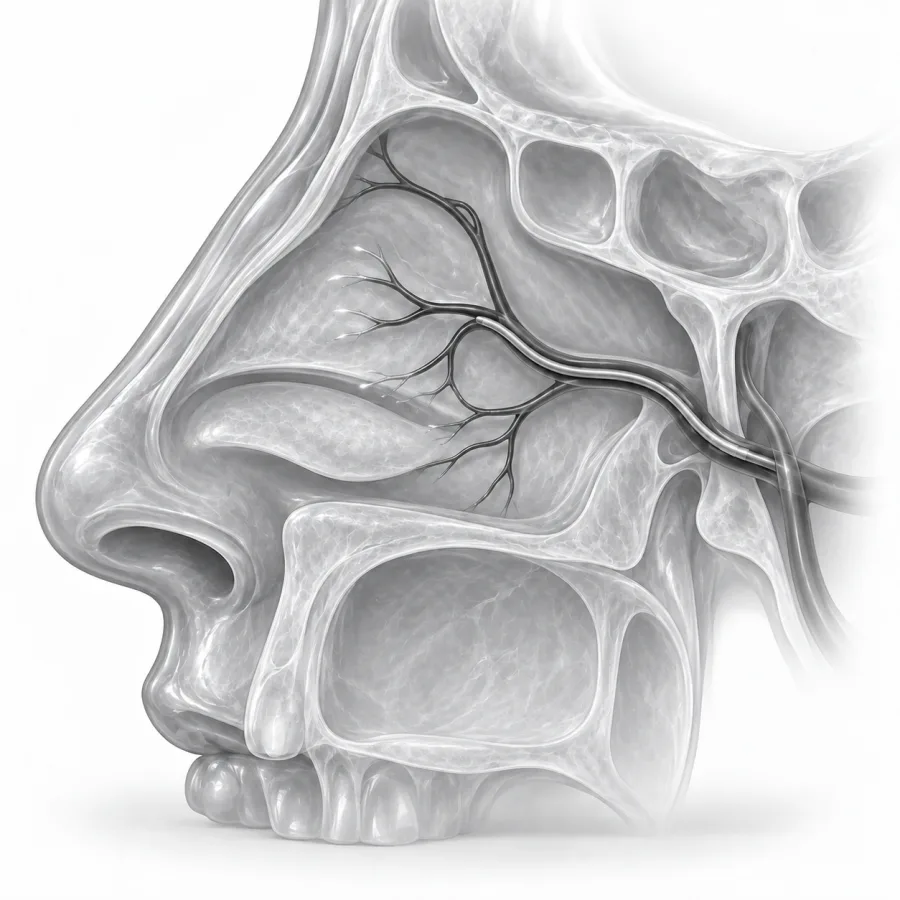
 On imaging
Cerebral angiogram: contrast shows the arteries of the head and face.
Brain Bleeds to Fibroids: Same Results, Tiny Incision
Dr. Fabio Komlos walks through epistaxis embolization the way he explains it in clinic, using the same images he uses to plan treatment.
Fabio Komlos, MDInterventional radiologist · 2:25After Embolization? Don't Make These 5 Mistakes
5:32
Everything you need to know about angiograms and what to expect after
13:56
What problem does it treat?
A nosebleed, called epistaxis, is very common and almost always stops with pinching the nose. Most start at the front of the nose. A small number come from further back, where larger arteries run, and these can be heavy, hard to reach and keep coming back. They are more common in older adults, people with high blood pressure, and people who take blood thinners.
The nose is fed by two sets of arteries. Most of the blood comes from branches of the external carotid artery, especially the sphenopalatine artery, which enters at the back of the nose. Some comes from branches of the internal carotid artery, the artery that also feeds the eye and brain.
Embolization means blocking a blood vessel on purpose. In epistaxis embolization, we guide a thin catheter to the small arteries feeding the nose and plug them with tiny particles or coils. The pressure of blood reaching the bleeding spot drops, and the nose can heal. Other arteries keep the nose alive, so the tissue survives.
Who it helps and who it may not
Good candidates
- Nosebleeds that keep coming back despite packing and cautery
- Bleeding from the back of the nose that is hard to reach
- People who are not good candidates for general anesthesia and surgery
- Bleeding that continues after endoscopic surgery
- Bleeding after injury or surgery to the face or sinuses
- Some people with hereditary hemorrhagic telangiectasia (HHT), an inherited condition with fragile vessels
May not be right if
- The bleeding comes mainly from internal carotid branches (such as the ethmoid arteries), which usually need surgery instead
- The bleeding spot can be easily found and treated with cautery
- Severe allergy to contrast dye or serious kidney problems (can sometimes be managed)
- Blood vessel anatomy that makes it unsafe to reach the nasal arteries
The decision is usually made together with an ear, nose and throat (ENT) surgeon, often while you are in the hospital with packing in place.
How it compares with the alternatives
Most nosebleeds are managed step by step: pressure, medicine sprays, cautery (sealing the spot with a chemical or heat), and nasal packing. If bleeding continues, the two main options are embolization and endoscopic surgery by an ENT surgeon, who ties or clips the sphenopalatine artery through the nose.
| Embolization | Endoscopic artery ligation | Packing alone | |
|---|---|---|---|
| How it's done | Catheter through the groin or wrist | Camera and tools through the nostril | Sponge or balloon placed in the nose |
| Anesthesia | Moderate sedation or general | General anesthesia | Local numbing |
| Stops bleeding | In about 8 to 9 in 10 | In about 8 to 9 in 10 | Often, but bleeding may return when removed |
| Main downsides | Rare stroke or vision risk; facial pain | Crusting, sinus problems | Uncomfortable; days in place |
| Can treat ethmoid arteries | No | Yes | Not specifically |
Both embolization and surgery work well. Embolization avoids general anesthesia in many cases and can treat several arteries on both sides at once. Surgery is preferred when the bleeding comes from arteries that are branches of the internal carotid system. Treating the underlying cause, such as high blood pressure or a blood thinner dose, is part of every plan.
Before the procedure
Most people are already in the hospital when embolization is planned. You may have nasal packing in place, and we may check your blood count and clotting tests and give fluids or a blood transfusion if you have lost a lot of blood.
- Do not eat for about 6 hours beforehand, if there is time.
- Tell us about blood thinners and antiplatelet medicines. Your care team will decide whether to pause or reverse them. See blood thinners.
- Let us know about allergies to contrast dye and about kidney problems.
- A CT angiogram of the head and neck is sometimes done first to look at the arteries.
What happens, step by step
- 1Getting ready
You receive moderate sedation or, if you are bleeding heavily or need your airway protected, general anesthesia. Packing usually stays in place during the procedure.
- 2Mapping the arteries
A small tube is placed in the groin or wrist artery. We guide a catheter to the carotid arteries in the neck and inject contrast dye to see the arteries of the nose and check for dangerous connections to the eye and brain.
- 3Blocking the feeding arteries
A very thin microcatheter is advanced into the sphenopalatine artery and sometimes the facial artery. Tiny particles, sometimes with coils, are injected to slow flow to the bleeding area, often on both sides.
- 4Finishing
A final picture confirms reduced flow. The tube is removed and the pinhole is sealed with pressure or a closure device.
What we seeBefore I place a single particle, I study the angiogram for small connections between the nasal arteries and the arteries that feed the eye and brain, because those are what I must protect. I choose particles large enough to stay in the nose and inject slowly while watching every frame. When I talk with patients and families, I am honest that this works very well most of the time, and that the ENT team and I will still have a plan if it bleeds again.Fabio Komlos, MD, interventional radiologist · About Dr. Fabio Komlos
Recovery and aftercare
- First 4–6 hoursBed rest while nurses check the puncture site, your nose and your neurological function. You can usually eat once awake.
- Day 1–2Nasal packing is usually removed by the ENT team 24 to 48 hours after embolization. Most people go home 1 to 2 days after the procedure.
- First 1–2 weeksAvoid blowing your nose hard, bending over, straining, heavy lifting and hot drinks or hot showers. Sneeze with your mouth open. Use saline spray and a humidifier to keep the nose moist.
- 2–4 weeksMild facial ache, jaw pain or numbness usually settles. Follow up with ENT and your primary doctor, especially for blood pressure.
Results and risks
Embolization stops the bleeding right away in most people, and about 8 to 9 in 10 do not bleed seriously again. Some people have a minor nosebleed later, which usually responds to simple measures. If a major bleed returns, the options are a repeat embolization or surgery.
Common, usually mild
- Facial pain, jaw pain or headache for several days
- Numbness of the face, cheek or palate, usually temporary
- Crusting in the nose
- Bruising at the groin or wrist
Rare but serious
- Stroke or vision loss if particles reach the brain or eye arteries, in about 1 in 100 or fewer
- Damage to the skin or lining of the nose or face from reduced blood flow
- Facial nerve weakness
- Bleeding at the puncture site or artery injury
- Reaction to contrast dye or kidney strain
Common questions
Is it safe to block arteries to the nose?
Does it hurt?
Will the nosebleeds come back?
Can I go back on my blood thinner?
When can I fly?
Why did I get this nosebleed?
Middle meningeal artery embolization
Treat a chronic subdural hematoma through a pinhole and lower the chance it comes back.
Arteriovenous malformation embolization
Close the abnormal artery-to-vein connections of an AVM through a pinhole, without surgery.
Blood thinners and your procedure
Which blood thinners may be paused before a procedure, typical hold times, and how bridging works.
Sedation and anesthesia
Local numbing, twilight sedation and anesthesia: what you feel and why you need a ride.
Written for patients by the Palo Alto Interventional team. General information only; your own plan depends on your health and imaging.
Talk to us about your options
Request a consultation online, or call 650-404-8445, Monday to Friday, 8 am to 5 pm. You can also ask your doctor to send a referral. We will review your imaging and help you decide whether a procedure makes sense.