
Basivertebral nerve ablation
Relief for chronic low back pain that starts in the vertebrae.
Some long-lasting low back pain comes from the vertebrae themselves, not the discs or joints. Basivertebral nerve ablation uses gentle heat, through a needle, to quiet the nerve that carries this pain. Nothing is implanted and nothing is fused.
- Outpatient
- About 1 to 1½ hours
- Moderate sedation
- Home the same day
 Fabio Komlos, MDInterventional radiologist
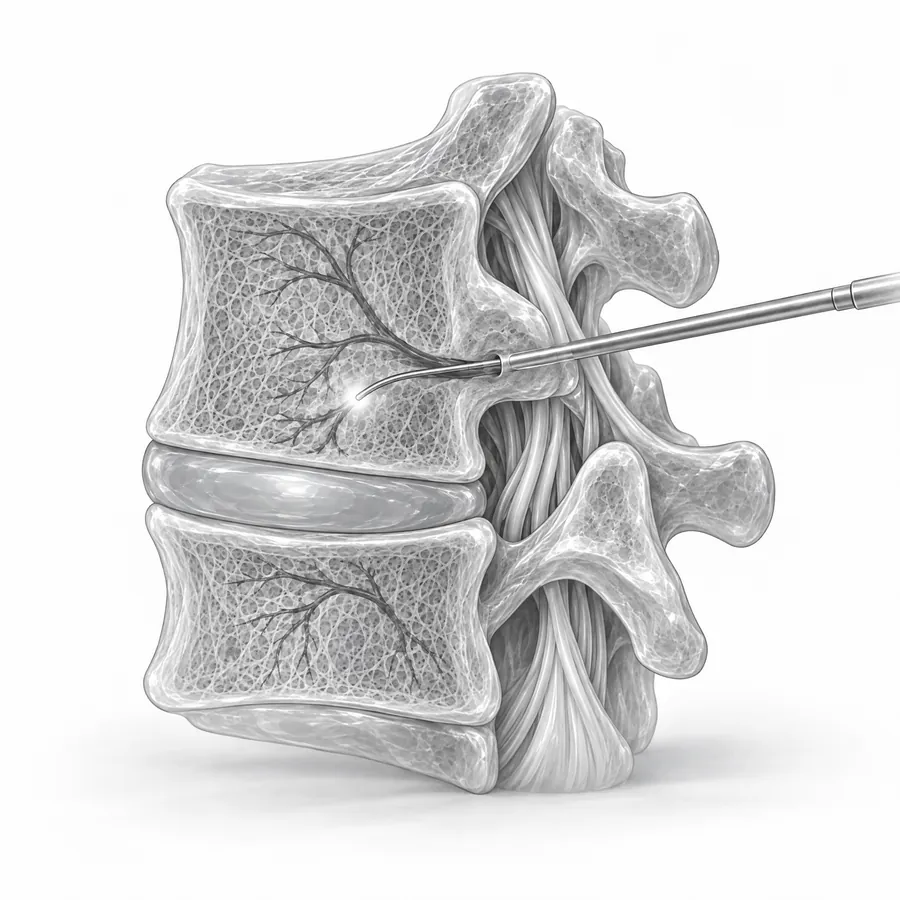
Two small needle openings in the lower back.
What is basivertebral nerve ablation?
Each bone of the spine (vertebra) has a flat top and bottom, called the endplates, that rest against the discs. With wear and tear, these endplates can become damaged and inflamed. A small nerve inside the bone, the basivertebral nerve, carries pain signals from the endplates. This kind of pain is called vertebrogenic low back pain. It is felt in the middle of the lower back and is often worse with sitting, bending forward and activity.
In basivertebral nerve ablation, the doctor passes a thin needle into the vertebra using X-ray guidance, then places a small probe right on the nerve where it enters the bone. The probe heats the nerve with radio waves, so it stops sending pain signals. The procedure is sometimes called by a device name, such as Intracept.
The nerve sits inside the vertebra, in front of the spinal canal, and well below the end of the spinal cord. The bone, disc and joints are left in place, and nothing is implanted. This is different from spinal fusion surgery.
You may also hear it called intraosseous basivertebral nerve ablation, BVN ablation or vertebrogenic pain ablation. It is not related to the vertebrobasilar arteries of the neck.
Who it helps, and who it doesn't
The key is the MRI. Vertebrogenic pain leaves a recognizable pattern called Modic changes, which are swelling (type 1) or fatty change (type 2) in the bone next to the endplates. To be a candidate, these changes need to be at one or more of the lowest lumbar levels, from L3 down to S1.
Good candidates
- Low back pain, mostly in the middle of the back, for 6 months or more
- Back pain is the main problem, more than leg pain
- Modic type 1 or 2 changes at L3, L4, L5 or S1 on MRI
- Physical therapy, exercise, medicines or injections have not helped enough
- You want to avoid or delay spine surgery
May not be right if
- Your main symptom is sciatica, leg pain or numbness from a pinched nerve
- Your pain comes from spinal stenosis, a slipped vertebra, a disc herniation or the facet joints
- You have a spine fracture, infection or tumor at the level to be treated
- You have severe osteoporosis
- The same vertebra was already treated, or was fused in surgery
We review your MRI, your history and your exam together. If another cause explains your pain better, we talk about treatments for that cause instead, such as an epidural injection or a nerve block.
How it compares with other options
| Compared | Basivertebral nerve ablation | Injections | Spinal fusion |
|---|---|---|---|
| What it targets | The pain nerve inside the vertebra | Inflammation around nerves or joints | Movement between vertebrae |
| How it is done | Needle through the back, X-ray guided | Needle through the back, X-ray guided | Open or minimally invasive surgery |
| Implant | None | None | Screws, rods or cages |
| Recovery | A few days to 2 weeks | 1 to 2 days | Months |
| How long it lasts | Years in long-term studies | Weeks to months, often repeated | Permanent change to the spine |
Getting ready
- Bring or send your most recent lumbar spine MRI. If it is old, we may ask for a new one.
- Tell us about blood thinners. Some need to be paused before a spine procedure. See blood thinners.
- Tell us if you have a pacemaker, defibrillator, spinal cord stimulator or other implanted device.
- Do not eat or drink for about 6 to 8 hours beforehand, because you will have sedation.
- Arrange a ride home. You cannot drive after sedation.
Read more in before your procedure and sedation.
What happens during the ablation
We do this procedure at El Camino Hospital in Mountain View, with moderate (twilight) sedation, and you go home the same day.
- 1Getting comfortable
A nurse starts an IV, gives you an antibiotic and moderate sedation, and connects heart, blood pressure and oxygen monitors. You lie face down. The skin of your lower back is cleaned and numbed.
- 2Reaching the nerve
Using live X-ray, the doctor passes a thin needle through the back part of the vertebra (the pedicle). A small curved tool then makes a path to the center of the bone, where the basivertebral nerve enters.
- 3Treating the nerve
A radiofrequency probe heats the nerve for several minutes. This is usually repeated in a second vertebra, because each disc level has a vertebra above and below it.
- 4Finishing
The needles are removed, and each small opening gets a bandage or a skin closure. You rest in recovery for about an hour before going home.
Recovery and results
- First 2 daysTake it easy. Soreness at the needle sites and a temporary flare of back pain are common. Ice and over-the-counter pain medicine help. No driving the day of the procedure.
- Days 3 to 7Most people return to desk work and light activity. Avoid heavy lifting and strenuous exercise until we tell you it is fine.
- 2 to 6 weeksPain usually starts to ease. Relief often builds gradually rather than all at once.
- 3 months and beyondThis is when results are usually judged. In long-term studies, the improvement lasted 5 years or more for many people.
Basivertebral nerve ablation has been studied in two randomized trials, one comparing it with a sham (pretend) procedure and one with standard care, plus long-term follow-up. In a combined review of the studies, about 2 in 3 people had at least half their pain relieved at 1 year, and 3 in 4 had a meaningful improvement in daily function. At 5 years, about a third of patients were pain-free, and many who took opioid pain medicines had stopped.
Results vary. Some people get little benefit, and the sham-controlled trial showed that part of the early improvement is a placebo effect. Most studies were funded by device makers. We talk through what is realistic for you.
Many of my patients with chronic low back pain have spent years on physical therapy, medicines and injections, and were told the next step is surgery. When the MRI shows the typical endplate changes, this procedure treats the pain at its source with two small needle openings, and leaves the spine as it is. I look carefully at the MRI and the exam with each person, because choosing the right patient is what makes it work.Fabio Komlos, MD, interventional radiologist · About Dr. Fabio Komlos
Risks
Basivertebral nerve ablation is considered low risk. In the clinical trials, serious problems caused by the device were not reported.
- Soreness and bruising at the needle sites, and a temporary flare of back pain.
- Temporary irritation of a nerve root, which can cause leg pain or tingling for days to weeks.
- Infection or bleeding, uncommon.
- A fracture of the treated vertebra, rare and more likely with weak bones.
- Risks of sedation, which our nurses and anesthesia team manage.
- The pain may not improve, or other back problems may continue to cause pain.
Common questions
Does it hurt?
Is anything left in my body?
Could it damage my spinal cord or leg nerves?
How do I know if my pain is vertebrogenic?
How long does the relief last?
Can it be repeated?
Can I still have surgery later?
Will insurance cover it?
Supplies for home
Patients often ask where to find these. Here are some easy options we have found; they are not endorsements, and not always the best product or lowest price. Buy from wherever is easiest, and ask us if you are not sure a product fits your needs.
Back pain relief
As an Amazon Associate, Palo Alto Interventional earns from qualifying purchases.
Epidural steroid injections
Ease sciatica, arm pain or back pain with a precise, image-guided steroid injection.
Spinal cord stimulators
Quiet chronic back, leg or nerve pain with a small implanted device you test first.
Nerve blocks
Pinpoint and calm the nerve carrying your pain with a precise, image-guided injection.
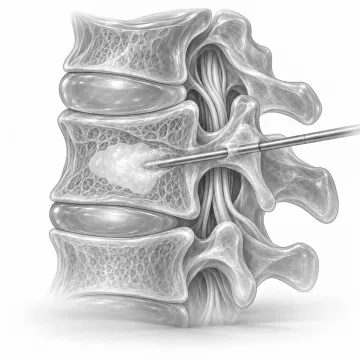
Kyphoplasty
Stabilize a painful spine compression fracture with bone cement, through a needle.
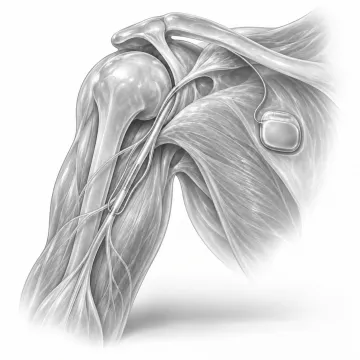
Peripheral nerve stimulators
Ease pain in the back, shoulder, knee or a limb with a thin wire and gentle electrical pulses.
Written for patients by the Palo Alto Interventional team. General information only; your own plan depends on your health and imaging.
Talk to us about your options
Call 650-404-8445, Monday to Friday, 8 am to 5 pm, to book a consultation. You can also ask your doctor to send a referral. We will review your imaging and help you decide whether a procedure makes sense.